
Around the time Enslaved: Odyssey to the West launched, I drafted a feature looking at every game inspired by the famous Chinese novel Journey to the West. Despite having a fondness for Monkey King and co, this planned piece didn’t come to fruition. We’ve seen so many recent releases based on the novel, including Black Myth: Wukong and Crown of Wu, that creating said feature would be far more difficult now than in 2010. And here comes another, proving that Journey to the West adaptations show no sign of slowing. That feature will have to wait.
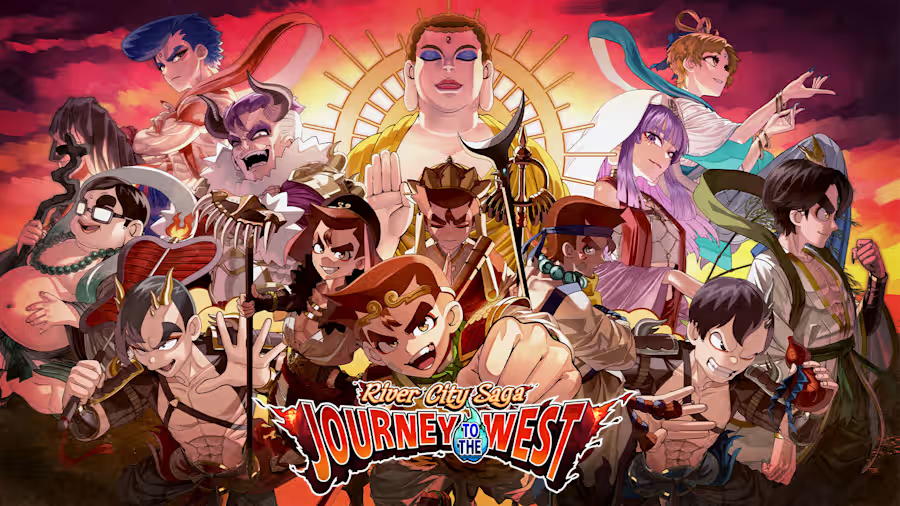
Killing two birds with one stone, River City Saga – linked to the NES classic River City Ransom – is both the first roguelike in the series, and the first franchise spin-off to be based on Journey to the West. Duly, it features the cast of the 8-bit brawler, along with cameos from other Technōs properties, depicted as Sun Wukong, Zhu Bajie, and Sha Wujing. These three form the playable character roster, each with a unique fighting style, varying from melee to ranged. It’s a comical take on the novel, seeing the trio set out to Tianzhu, making a few blunders along the way. Text-based dialogue screens are frequent (and skippable), and the artwork is well drawn, packed full of detail and exaggerated expressions. The mix of 2D sprites and softly coloured 3D battle arenas works well too, accompanied by flashy super move effects.
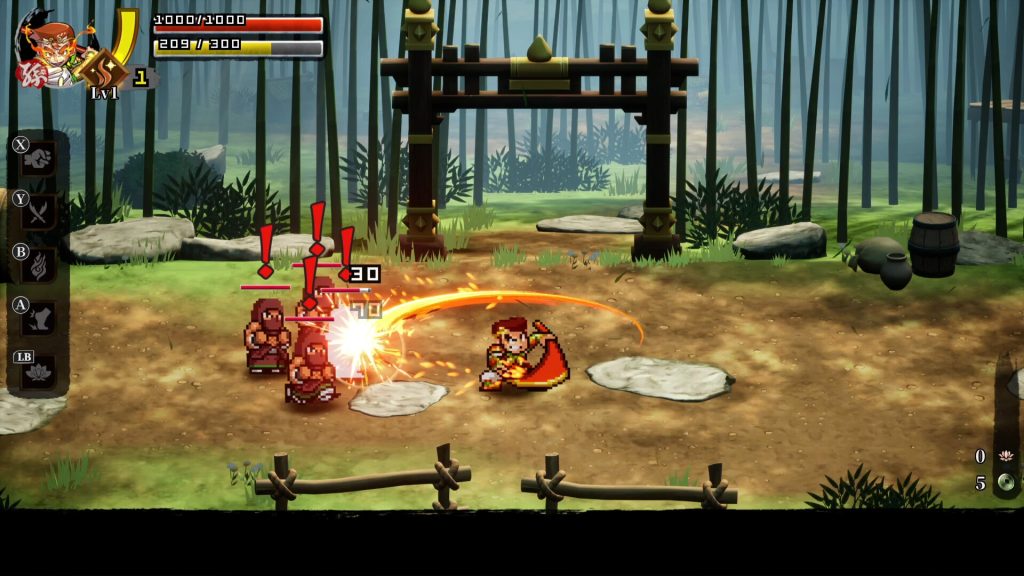
As this is a roguelike brawler, we’re thrust into small stages spanning a couple of screens to pummel waves of enemies before choosing one reward from a choice of three, two of which are usually in-game currencies that unlock permanent upgrades. There are four stages in total, each with around ten levels lasting just a couple of minutes, including boss battles where you’ll receive a blessing. Blessings are the real ‘game changers’, as they can increase attack damage, critical rates, and movement speed, or add a new special move such as a flaming flying kick that you’re able to direct while mid-air. Alternatively, there’s a gassy fart cloud that harms several enemies at once. Delightful.
Battles are fast-paced, largely due to the amount of dashing involved. You’ll be dashing just as much as button-bashing melee attacks, as the screen is often filled with glowing indicators to highlight incoming enemy attacks. You’ll also get a heads-up when an enemy is about to throw a bomb or similar, making avoiding hazards a simple enough task. Battle arenas feature traps too, all of which provide a few seconds to react, be it spiked floors or explosive barrels.
Most boss fights are against characters no bigger than yourself, although sometimes you’ll have to go up against two at once. Two more elaborate battles also feature – one being the final boss – although these are weirdly similar, involving colossal deities with disembodied ground-pounding fists to attack before unleashing your strongest moves on their giant noggins. Together with the brief runtime, it is a little light on content outside of its elongated unlock lists. This is an experience intended to be replayed several times over, with runs lasting only around 30 minutes.
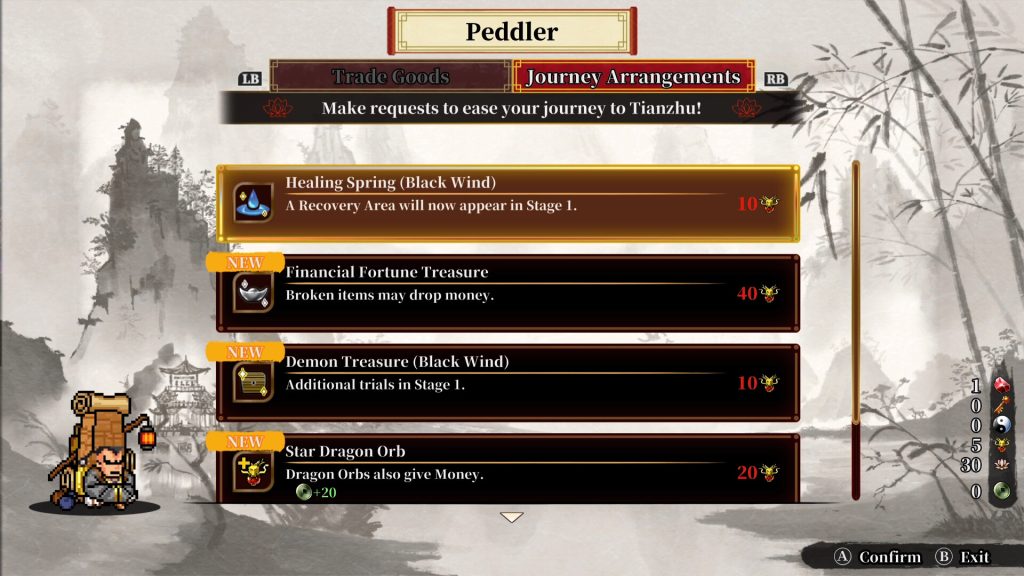
One of the most vital upgrades is the ability to leave a damaging circle behind when dashing. You can also increase knockback, add a shocking ability, summon a portal to drop random items onto enemies’ heads, and later gain a few of the bosses’ attacks too. There’s a wealth of permanent upgrades to invest in mid-run (which is also where progress can be saved, incidentally), and although this can be initially confusing due to the number of in-game currencies, it doesn’t take long to discover which are the most beneficial. Challenges too bestow extra currency, each linked to the PlayStation Trophies, which are handed out here liberally. Lastly, more trials can be added to each stage, bestowing a chest if you’re able to defeat an extra wave of enemies.

As roguelikes go, this isn’t too time-consuming or taxing overall. In fact, it’s surprisingly easy-going, edging towards casual. It’s very much a case of button-bashing your way to victory while dashing all over the place, occasionally performing an ultimate or super move to defeat several enemies at once. I managed to see the ending screen (which requires all four stages to be beaten twice) after just three hours of play. This was achieved by investing in more health and increased default attack damage, along with purchasing two items granting instant revives. If things aren’t going your way, it’s possible to purchase additional rest points – or alternatively, the damage ratios can be altered in the options menu. There is quite a bit to see after completing a run, though, including secret blessings – gained by gifting the sorcerer’s stone to different characters.
River City Saga: Journey to the West is easy to get into, while also suffering slightly from being too difficult to master. Through its fast-paced and occasionally flashy combat, it offers a fun time, and the ability to invest in extra rest points and greatly extend your base health allows you to dumb down the difficulty considerably. The downside of this is that you may not end up glued to it for long – after five hours of play, I felt like I had my fill. While it does have a few secrets to find, that’s pretty much all there is; it’s an experience intended to loop until tedium settles. It’s still a fun enough time; certainly, enough to make me curious about where the River City cast will wind up next.
Arc System Work’s River City Saga: Journey to the West is out now on PS5, Switch and PC.