
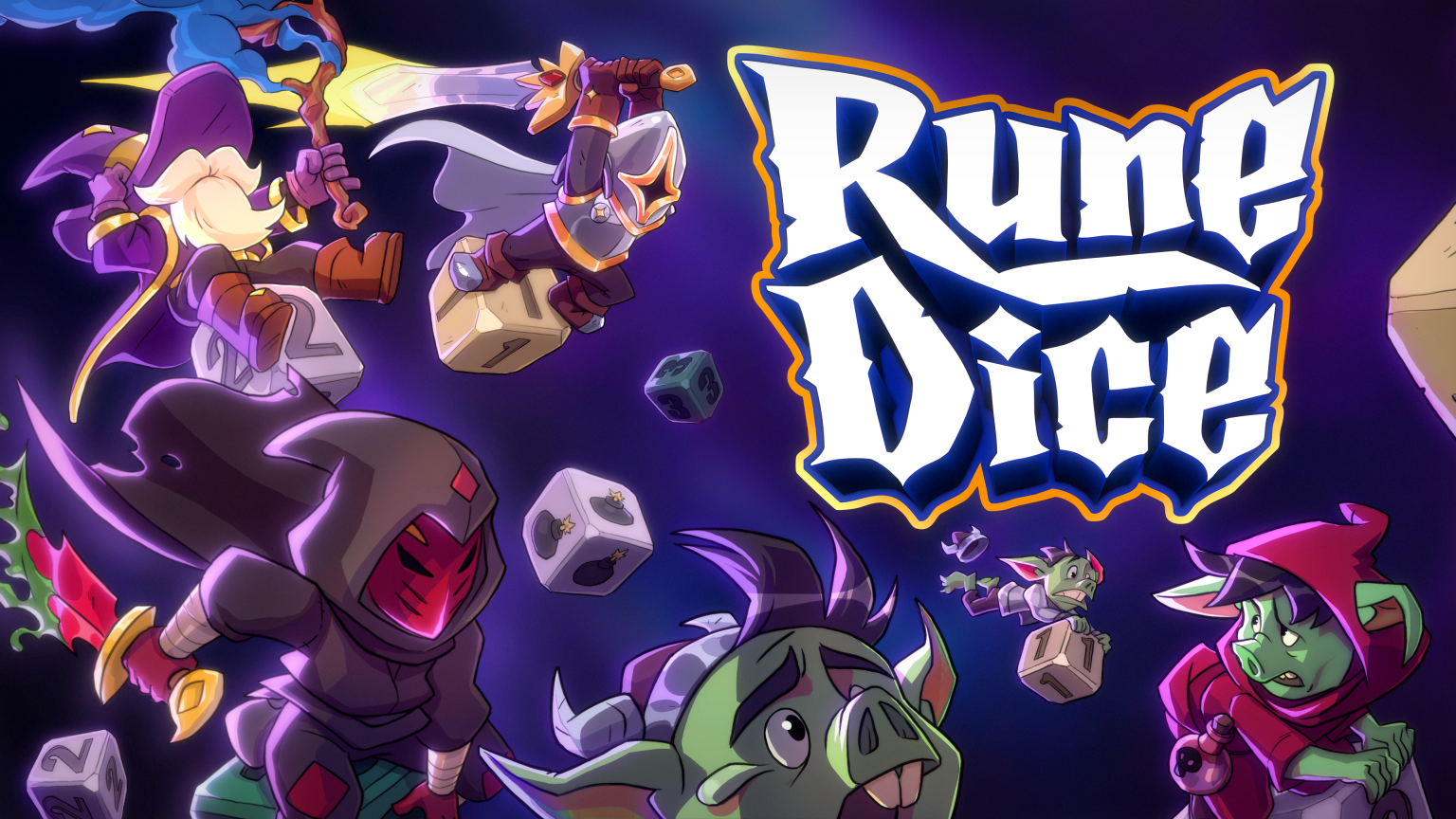
Many indie games in the roguelike genre can be considered unassuming. Rune Dice fits that bill, predominantly featuring a single screen consisting of a dice pit and little else. The same could also be said for the smash hit Vampire Survivors, with its diminutive crudely animated sprites. It’s not until playing these games for a few minutes that you begin to realise that a lot is going on behind the scenes. As not to dogpile Rune Dice further, this isn’t exactly something that could have existed in the ‘90s either – while it uses small pixel art characters for its battle animations, the physics-enabled dice would have probably made even the SNES stutter.
Predictably, Rune Dice has a tutorial. Whether it was required though is debatable as the concept is graspable in a matter of seconds. Here, we’re flicking die at other numerically matched die, which then increase in value before being ‘pulled’ towards others of the same type. Upon coming to a standstill, values are then tallied, becoming damaging blows to the enemies lined up along the top of the screen. Every few turns an extra die, rune, or health top-up can be selected, with new dice then added to the pool. These are decorated accordingly and will either implement elemental damage (fire, lightning, ice, etc), add cash, or restore health.
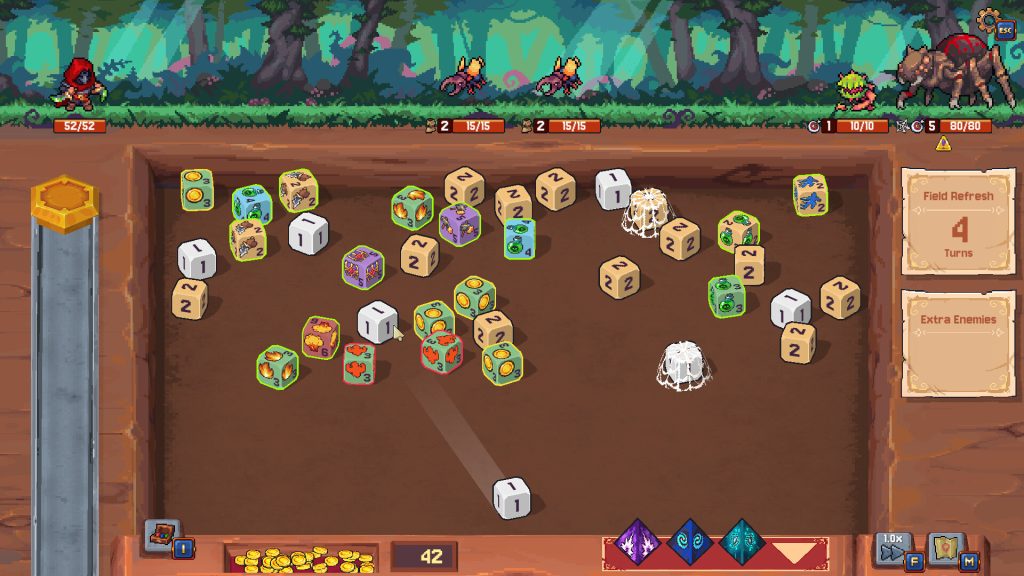
Runes meanwhile are single use and usually grant a special ability that can turn a battle in your favour. Most handy is the ability to switch the order of enemies, allowing bosses to be attacked directly instead of wading through their minions. In fact, you’re best off saving runes for bosses, as there are no continues and only one life is given per run. You’ll need everything you’ve got to overcome their special abilities – including goo pools and die-snagging spiderwebs – and only by crossing a boss off your list can you progress to the next area.
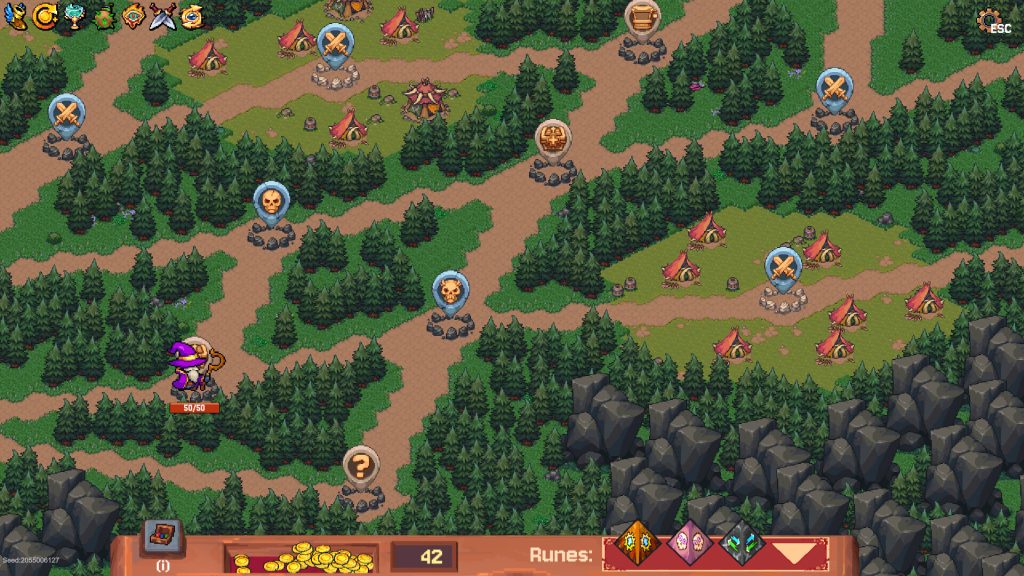
This brings us on to Rune Dice’s structure. The three worlds – including a goblin filled grassland and a desert rife with mummies – have three bosses that can be selected freely, and only after all three are defeated will the next location unlock. Once a run is complete – a task that takes 20-25 minutes – you’re thrown back to the menu screen, although not without a minor increase to your chosen hero’s stats. Only two classes are available from the outset, including a rogue who can backstab enemies at the back of the queue, with more unlocking along the way. Stages meanwhile use a branching path, featuring short battles, shops, rune fusion chances, treasure chests, and jester encounters that can potentially end in a full coffer of cash.
The actual die flicking aspect is moderately engaging, not dissimilar to a top-down pool/snooker sim in the way that you need to think a step or two ahead, planning where your dice will land and which other dice it may potentially collide with. Fine aim allows you to knock just the corner of a die into others, and it’s possible to bounce it off walls. I would however hesitate to call these trick shots. There’s no power gauge either, and every die flick commences in the same place – unless you happen to grab the relic that allows you to reposition a single flick. There’s still the potential to amass a long succession of blows, turning the default ‘1 die’ into a ‘sixer’ blessed with an additional shockwave. As screens are reset every five turns, turning every die into a ‘sixer’ isn’t an eventuality, which does scrub the chance to become overpowered.
It’s the means of restoring health that ended many of my runs. See, health dice can be added to your pool, along with shields, but these are only minor increases. To gain a significant amount of health, you’ll need to rely on it appearing as a selectable at the end of a battle, which means missing out on essential runes. Several runs ended after reaching a boss with next to no health, resulting in the battle being over in a few turns. Indeed, balancing offence with defence is a very tricky task. Not impossible, but I did feel the need to grind to raise a hero’s base HP. Sure, I wasn’t expecting to wade in and beat every boss on the first attempt, but neither did I expect to feel like the odds were unfavourably stacked either – especially in something that largely boils down to flicking dice and watching them bounce around. That said, the fact that dice are ‘magically’ drawn towards one another goes a long way to preventing this from feeling overly random, while also indicating that a lot of fine-tuning occurred before release.
There’s a lot to be said about Rune Dice’s simplicity. There is an air of elegance to it, and it’s certainly very easy to get into. When replaying past stages, though, or simply trying to grind to take on one of the harder bosses, it’s very much a case of switching your brain off and simply taking potshots over risky gambles.
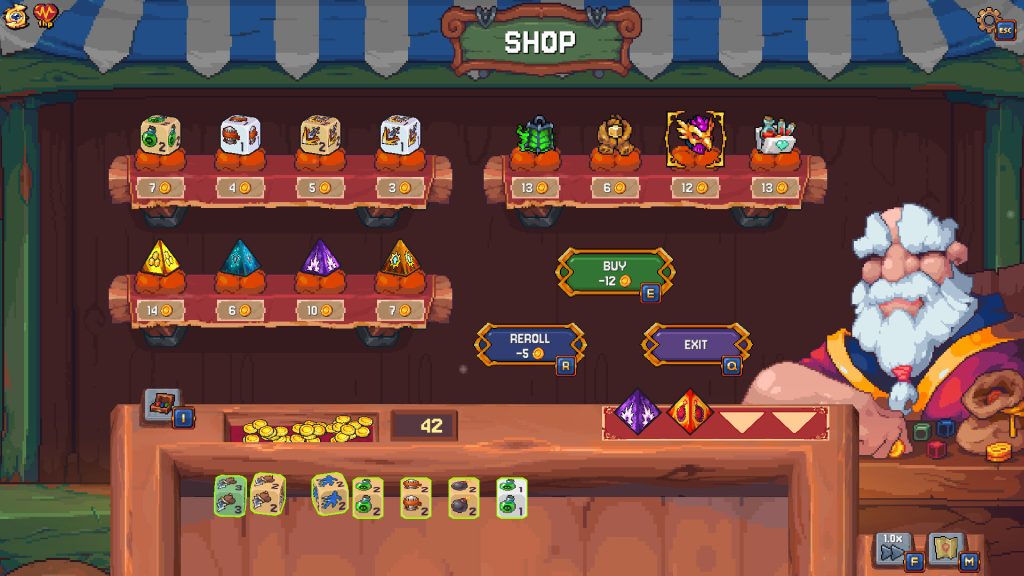
It would have benefited from a bit more personality too, with only the hirsute shopkeeper’s comical gestures standing out. The music is at least more lively, complementing the colourful visuals well. If you’re dexterity-challenged and looking for an uncomplicated roguelike, this is worth throwing a few coins at. Roll up, roll up.
Smart Raven Studio’s Rune Dice is out 19th May on all formats. Published by Kwalee.