

After playing so many half-baked and downright lazy auto-shooters, all hoping to cash-in on Vampire Survivor’s success, it’s understandable why I approached Submarine Survivor with caution. It seems that developers are currently scrambling to base their survivor games on certain distinct themes before anyone else, paying little attention to trying to implement new ideas outside of their setting, be it sci-fi, medieval, prehistoric, or in this case underwater.
It turns out that I should’ve had more confidence in developer The Bat Flight, as the deep-sea setting – pitting your submarine against various sea creatures – isn’t the only thing going for it.
What we have here is an auto-shooter with a structure, involving choosing five-minute missions from a hex-based grid, with the goal being to break a ‘threat threshold’ to summon the boss. Upgrades carry over from one mission to the next, and there’s a chance to recuperate health. Also between missions – which vary from avoiding falling bombs to remaining in a marked area – you’re able to invest in permanent upgrades from a super-sized assortment. Not only this, but ore can be refined and used to improve items, with the amount of ore gained per refinement being randomised. Later, a trader appears too, swapping items for a temporary boost during a single run.
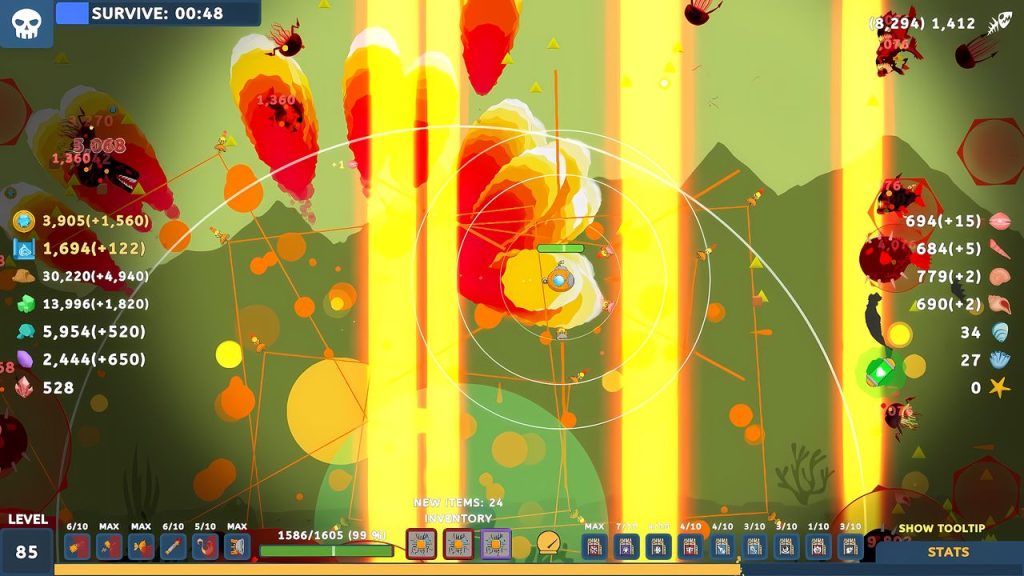
The core gameplay loop is familiar. You’re up against waves of enemies that become increasingly stronger as the timer ticks down. Each drops an XP token when killed, and upon levelling up a choice of three upgrades is given. Some will boost a certain stat such as damage, health or speed, while others may increase one or two stats significantly while taking away a few percent off another. Thanks to the underwater setting, weapons include sonars, mines, tridents, harpoons, torpedoes, flares, and more. The orbital laser is a highlight, incinerating numerous enemies as they enter the beam. Not very nautical, but very cool.
Every weapon can be improved several times over, and as only six can be carried at once it’s worth balancing their attack speeds and reach. Upon death you’re able to see a breakdown of stats, helping you to choose a better weapon selection on your next attempt.
At the start, only one submarine is available, favouring firepower. The second has stronger armour, and so forth. Swapping between subs gives scope for experimentation, and aiming to unlock them all – with the kill count setting the criteria – gives something extra to focus on.
The difficulty level is well-judged, as it was often in the final seconds of a five minute mission that I ended up meeting Davy Jones. The last thirty seconds can be tense, taking no risks and opting for upgrades that boost defence to maximise chances of survival.
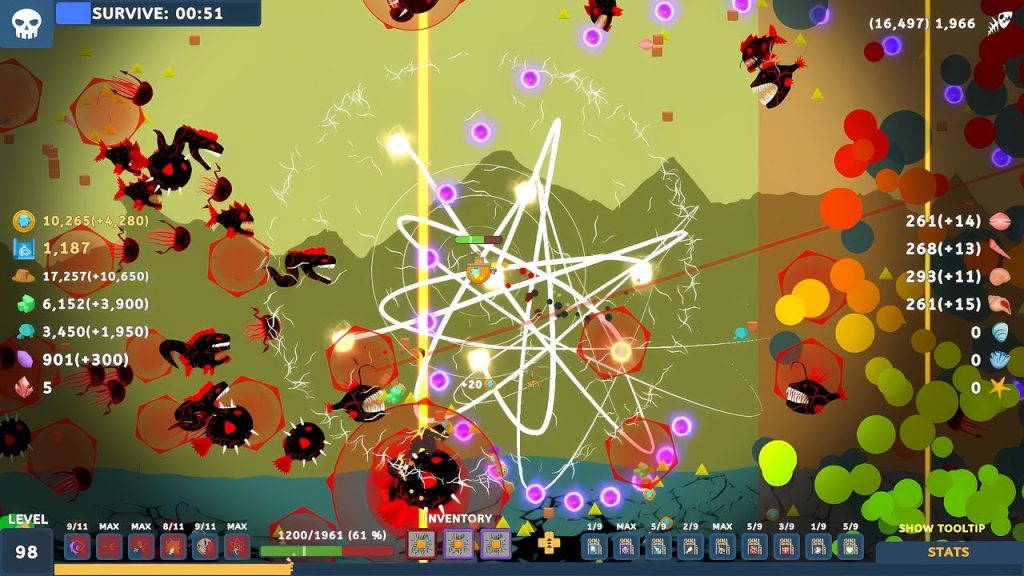
What’s neat about Submarine Survivor is that when a mission is complete you can choose to continue. No other enemies will spawn, making it easy (well, easier) to mop up any currency or XP left on the playfield. Die though, and the mission will be failed. Alternatively, you can try your luck on an extra two minute long tougher wave that dishes out sub-improving blueprints if successful.
The presentation is slightly slicker than other games in this price bracket (£4.49) with the visuals favouring a cartoony/comic book aesthetic. It’s very clean cut overall, which assists with identifying hazards. While there is dialogue when returning to the main menu screen, along with a tutorial to teach the basics, there isn’t much in the way of personality on display though. No salty seadogs or peg-legged captains – just your small orange submarine against red-eyed creatures from the murky depths.
Submarine Survivor stands out from other auto-shooters of late, feeling refined and fully featured, while even boasting thoughtful touches that you may not expect. If you aren’t yet suffering from auto-shooter fatigue, rest assured that there’s nothing fishy going on here.
The Bat Flight’s Submarine Survivor is out now on consoles. Published by eastasiasoft. A PC version launched earlier this year.