

1987’s Double Dragon was such a huge hit that bespoke conversions for all manner of formats were released for many, many, years after its arcade debut. The Atari Lynx version even released as late as 1993. As such, many gamers born in the ‘80s and ‘90s had very different experiences with the franchise’s beginnings. They may be most familiar with the arcade version, or perhaps the NES or Master System iterations. A very different era to that of today, where multiformat releases are almost identical. Sure, we miss the individuality of bespoke conversions, each having quirks. But it’s also reassuring to know that everyone receives the same experience nowadays.
A considerably fresh feeling experience, in this instance. Double Dragon Gaiden: Rise of the Dragons comes from indie developer Secret Base, who’ve been allowed to put their own spin on the franchise – hence the ‘Gaiden’ part of the title – to bring it into modern times. There are a couple of reasons behind this. Firstly, 2017’s Double Dragon IV wasn’t too hot, being very much a case of a publisher misguidedly creating something they believed the public wanted. After the excellent Double Dragon Neon, nobody was down for something crafted with NES sprite rips. Secondly, developers need to implement original ideas to stand out from the crowd. The scrolling beat’em up genre is thriving these days, successfully revived after being dormant for decades.
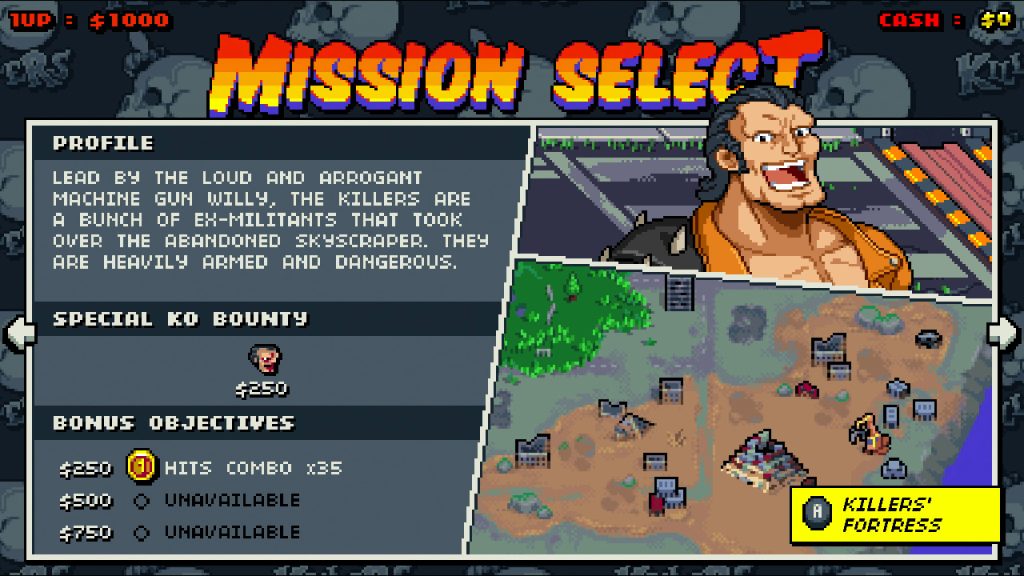
Double Dragon Gaiden is built on the foundations of Secret Base’s previous brawler Streets of Red, and due to its randomised elements, it can be considered a Roguelike. One thing you do have control over is the order in which the four main stages are played, each governed by a returning boss. The first stage chosen will always be a walk in the park. Once completed, the remaining bosses then rally their troops, making the other stages tougher. They’re also longer – essentially there are three variations of each stage, with new areas to beat added to those left for last. Additional areas are generally challenging, often adding platforming elements where miscalculated jumps can severely drain health. Boss battles also change depending on the order they’re tackled. Take on Machine Gun Willy as the first boss, and you’ll be presented with a straightforward battle in a basic room. Confront him last, and instead you’ll be taken to a rooftop battle involving a chopper.
This set-up allows for a remarkable amount of replay value, as you’ll need at least four playthroughs to see everything – with each playthrough lasting around 2 hours. Then on top of that, there’s an alternative ending – which entails an extra set of stages and the ‘true’ boss battle – plus a wealth of unlockable extras. The unlock menu isn’t filled with throwaway extras either; it features a bunch of new playable characters. Unlocking them all gives something to focus on, and the means of gaining (and keeping hold of) the in-game currency plays a big part. Cash is your lifeblood here, spilling out of enemies and gained by smashing up objects – a process that does slow the pace a tad. It’s used to purchase continues, buy randomised upgrades – which increase health, strength, special moves, and more – and once the ending credits rolls, remaining cash can be traded in for unlock tokens.
There’s even a modifier screen that adjusts the token exchange rate. The game can be made easy (or at least, easier) but only a few tokens will be dished out. Making the game tougher will bag a bigger bounty, and chances are you’ll want to knuckle down on acquiring enough to purchase every playable character – with the mystery character requiring a hefty 50 tokens.
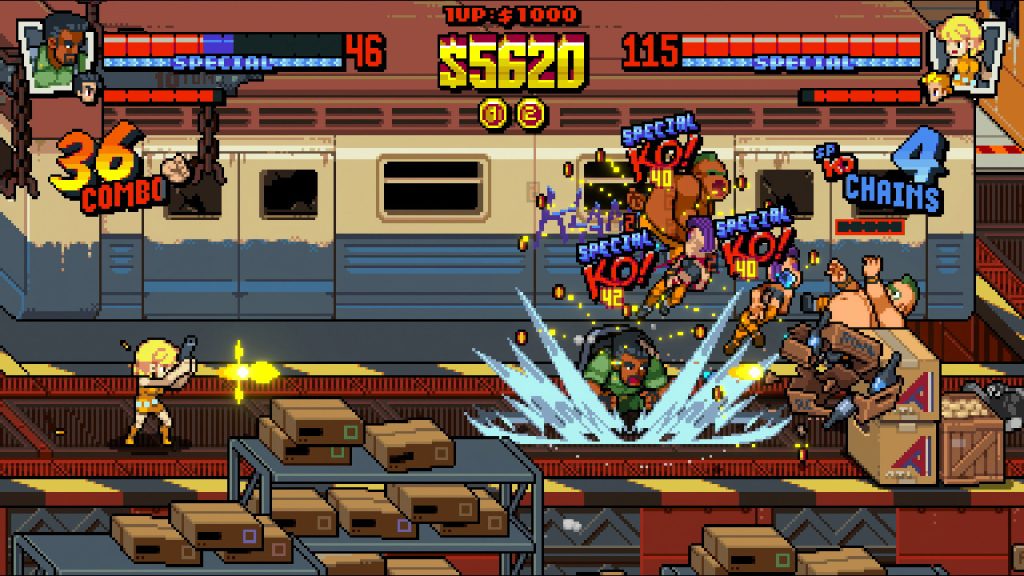
Two characters can be chosen and taken into battle. Yes, Double Dragon finally has a tag system. Tagging can be used to extend combos, and also allows a character to restore health while off-screen – much like tagging in Marvel vs. Capcom. What’s neat is that each character plays slightly differently. The story introduces us to a younger Billy and Jimmy, with one preferring to use their fists while the other uses swift kicks. They’re joined by their mentor Uncle Matin, who carries a riot shield, and the love interest Marian who uses a pistol, adding an impromptu scrolling shooter vibe.
While a lot of these new ideas are easy to comprehend, it was also a surprise to notice a lack of a tutorial. Instead, there’s a ‘how to play’ section on the pause menu, along with a move list that simply details each move rather than revealing button combos. This is because the special moves are allocated to a single button, performed based on enemy proximity. Each move drains SP, meaning they can’t be used continuously, only sparingly.
This also ties in with a ‘Crowd Control’ mechanic where defeating three or more enemies at once bestows a health pick-up – something quite satisfying as it’s accompanied by a splash screen and a chant. It also encourages you to line-up enemies so that you can maximise rewards. In addition to standard attacks, there’s also the ever-helpful jumping attack, along with a grapple for body slams and throws. Smaller characters can also pick up weapons, able to be thrown as projectiles.

Combat does feel a tad looser than in Streets of Rage 4, while the pacing is slower and less manic than TMNT: Shredder’s Revenge. The larger characters, in particular, move so slow that they bring the game to a crawl. The other faults here are mostly excusable. In addition to irksome platform jumping, you may find yourself being attacked off-screen via an enemy’s projectile weapon, which is quite an ‘old skool’ flaw. The enemies themselves aren’t too bright either, walking into the blast radius of dynamite and stepping onto spikes. Again relating to projectiles, they can be difficult to dodge as there’s no evasive manoeuvre other than a jump. I once became caught between two pistol-packing enemies, and rapidly lost most of a health bar. Also of note is that online play isn’t available at launch, planned for a future update.
These flaws don’t distract from the cathartic nature of the carnage to any major degree, making for a scrolling brawler that feels fresh and inviting. Franchise fans will also appreciate the nods to older games, such as one of the gangs having an Egyptian theme – a callback to Double Dragon III. The music is equally pleasing, featuring riffs on classic Double Dragon tunes.
While Double Dragon Gaiden may not be the next entry in the series that we were expecting, it’s the one that the franchise needs right now, successfully putting it back into the limelight. It knows how to grab your attention and has plenty to offer for those planning on unlocking everything.
Double Dragon Gaiden: Rise of the Dragons is out now on all formats. Developed by Secret Base and published by Modus.