

Contrary to popular belief, the humble SEGA Game Gear had more to offer than just Master System spillover, significantly scaled down Mega Drive conversions, and a bunch of licensed games of varying quality. Turn to the Japanese software library, and you’ll find an assortment of oddities that includes several exclusives from SEGA, a handful of accomplished RPGs, an eccentric mix of sports titles (Popeye Beach Volleyball, anyone?) and more.
It even boasts a few arcade-style shoot’em ups that command high prices nowadays, with 1991’s Griffin being one. This re-release marks its first official release in the west, and for the low price of £5.99. Considering a boxed copy will run you £100-£150, that’s quite the disparity.
The Game Gear wasn’t known for having a great selection of shoot’em ups, with the main reason springing to mind being the handheld’s poor screen. It was heavily prone to blurring, making games with lots of fast-moving sprites difficult to see. Couple this with the screen’s small size, and you can see why the likes of R-Type, Thunderforce, and Darius never graced the system. Even the few shoot’em ups SEGA released, such as Aerial Assault and Halley Wars, failed to win the hearts of ‘90s gaming journos during the Game Gear’s early days.
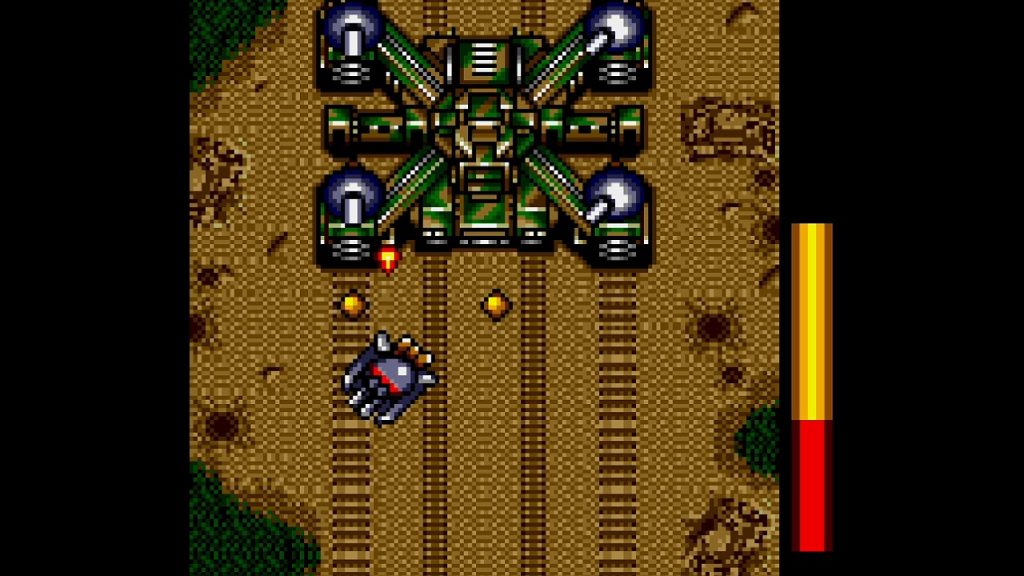
Enter Telenet Japan, who believed a decent shoot’em up was possible on the diminutive handheld. Griffin was a game built around the strengths and weaknesses of the Game Gear, utilizing a bright colour palette, chunky enemy projectiles, and a minimalistic HUD to free up screen real estate. Most crucially though, it put players in control of a futuristic tank, allowing the screen to be scrolled at your own pace. Rather than whizzing through stages, you’re instead slowly inching forward, never dealing with more than 3-4 enemies at once. Think along the lines of Konami’s Jackal for the NES, or perhaps Ikari Warriors.
By pausing you’re able to switch weapons from a choice of three, all of which can be upgraded. Power-ups and health top-ups are doled frequently, allowing weapons to be improved quickly after losing a life. Special weapons can only be fired upwards, while the basic weapon can be fired in different directions – including diagonally, which is essential for destroying turrets without being hit. There’s also a smart bomb with a neat ‘carpet bomb’ sweeping effect.
If you tread carefully and aim shots proficiently, it’s possible to get through stages relatively unscathed. Rather than die after taking a single hit, you’re able to withstand several shots – with the life gauge handily placed down the right-hand side of the screen. The final stage is appropriately the most difficult, throwing flame throwers into the mix.
Where Griffin falls short though is with the number of levels. It only has four stages, three of which must be replayed to unlock the true ending. Each has a boss, which are quite impressive visually in terms of size, while the few sub-bosses that feature are recycled a couple of times. You’re looking at around 30 minutes of playtime; which would have been sufficient for a journey to work or school back in 1991. Indeed, it pays to be mindful of Griffin’s roots.
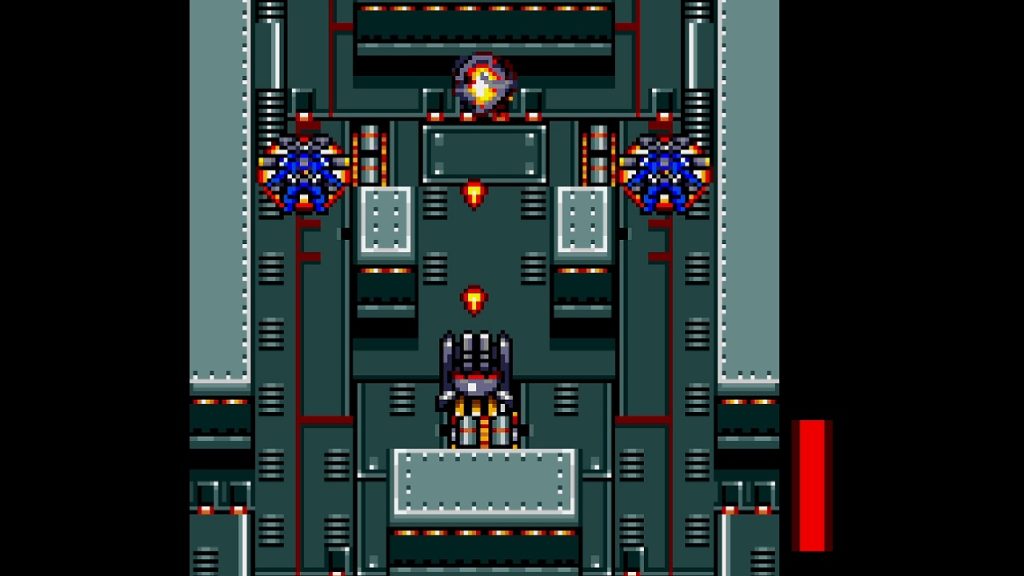
I had reasonably high expectations for the music, but it ended up being quite annoying, playing on short loops. I even had to turn the volume down during one mission. Although the visuals are quite chunky, obviously originally intended to help with visibility, they aren’t entirely without merit. Between stages a sultry image of the heroine appears – something which undoubtedly delighted ‘90s pubescent teens. Today, this idea feels a bit out of touch.
This re-release is presented the same way as Ratalaika’s Aero the Acro-bat re-releases, including save states, rewind and turbo tools, a scan of the Japanese box art and manual, and a couple of pieces of artwork. While the frontend isn’t exactly slick, which is perhaps to be expected considering the £5.99 price tag, it is at least easy to navigate.
There is something worth addressing before wrapping up this review, and that’s the fact that Griffin was never intended to be played on a large modern TV screen. When played from the comfort of a sofa, it’s very easy to forget that it was originally meant for a system with just two buttons and the screen the size of an After Eight. Having to pause to swap weapons feels like an inconvenience – when the minimalist HUD would have been a boon originally – and the chunky sprites intended for maximum clarity now come off as crude. On a Switch Lite however, it may fair a little better; Griffin was always meant for the smallest of screens. If you’re able to appreciate that, it isn’t a bad little diversion. A pint-sized shooter for the price of a pint.
Ratalaika’s Griffin is out now on all formats. Originally developed by Telenet Japan.