

If you’re glancing over Parkitect’s screenshots and wondering why it looks a few generations behind the times, then allow us to fill you in. The development of this theme park management sim began in 2014, ergo the start of the PS4/Xbox One era. After a successful Kickstarter and a spell in early access, the full release launched on PC in 2018. Several updates and two expansion packs later, it finally makes the jump to consoles via the conversion team at BlitWorks – although not without a false start, originally due late last year.
This console version has been a long time coming, but it is also worth the wait – the PC version was critically acclaimed, clearly born from a passion to create the definitive theme park builder.
The premise is much in line with expectations. You’re in charge of a secession of theme parks, and as manager, you must ensure the business is profitable by keeping customers happy and loyal. This entails hiring staff, designing park layouts, placing shops and rides proficiently, creating rollercoasters and track rides, investing in research, and decorating the park appropriately. It has a decent balance of simulation and realism, in that you must start out small and expand gradually, spending money wisely – and there’s a vast array of stat screens to dive into, showing incoming/outgoing expenses, heatmaps, visitor suggestions, and so forth.

Nothing out of the blue so far – especially if you’ve been playing games of this ilk since Bullfrog’s Theme Park in the early ‘90s. It’s the attention to detail and the wealth of customisation options that make this more than just another park builder. Almost everything can be tinkered with and customised, from the settings of the rides to the colour schemes of…well, just about anything. Visit the decoration menu, and amongst the wealth of trees, props, flowers, and lighting fixtures, you’ll find over 400 items that can be used to create unique backdrop elements, such as haunted houses and Wild West towns, or find fixtures to theme a ride. Land can be raised and lowered, and water/lava(!) features added too. Best of all, there’s little in the way of limitations as most items and decorations can be placed freely.
The campaign mode, too, has some thoughtful touches. Some parks are already up and running, with a few ideas provided for inspiration, while others have unique and challenging environments to construct within. They also begin with varied assortments of rides and shops available from the outset, so you’re never forced to start from square one. One early campaign mission involves creating a more regal and quieter park around a lake, in which a swan peddle boat ride can be placed, while another park must be built within the constraints of a narrow former airfield. There’s also a Wild West theme park to take over, in which the warm climate must be considered. As this is the deluxe version, it also includes Jungle and Candyland locations, with the former having ancient ruins to build around. All of these missions are involving, including a handful of objectives, resulting in a campaign mode that’ll take weeks to play through. That’s before even taking the additional sandbox mode into account.
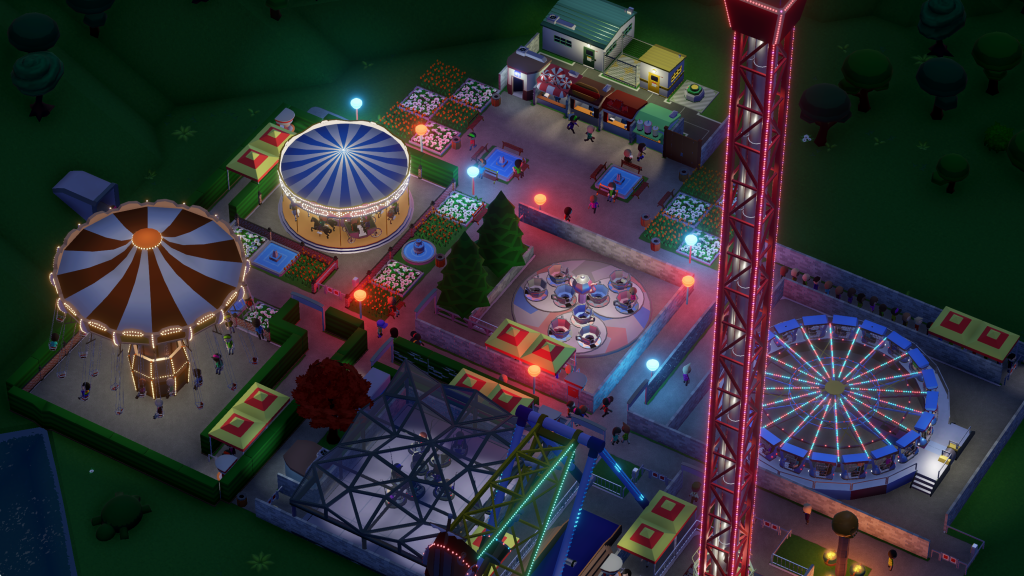
Adding an extra layer to park planning, Parkitect claims nobody likes seeing employees carrying out their duties. Specifically, ferrying goods to shops. This means placing employee-only paths behind the scenes, taking staff directly to locations without bumping into visitors, in addition to placing staff rooms out of public view. Stock deposits need to be built and linked to shops, with underground paths optional. You’ll also have to ensure that employee paths are covered by trees or similar, or else the park visitors will find their immersion shattered. Visitor’s AI is robust; they stick to paths and have demands to watch over. They like to have places to rest, and consume when hungry or thirsty. Vandals can cause havoc, breaking decorations, while if an influencer visits you may see a spike in popularity. Incidentally, and for those curious, visitors can potentially die by riding dangerous rollercoasters or from drowning. This greatly decreases your reputation with the public, harming visitor numbers.
Creating coasters, racetracks, log flumes, and other rides (large parks require transport to ferry punters around) takes a while to master. The UI is straightforward enough – aside from the cursor sometimes becoming obscured – but it’s still difficult to connect one end of the track to the other. It definitely requires practice and skill. Being able to zoom and pan while coaster planning would have helped. Menus elsewhere are easy to comprehend, with options spread over two radial wheels. Text can be made larger in the options menu, and the frequency of auto-saving can be adjusted. Good luck finding those auto-saves though, as we could only continue from manual saves. Playing on Xbox Series X before launch, we also lost all progress on one occasion. Hopefully, a future patch will rectify saving issues.
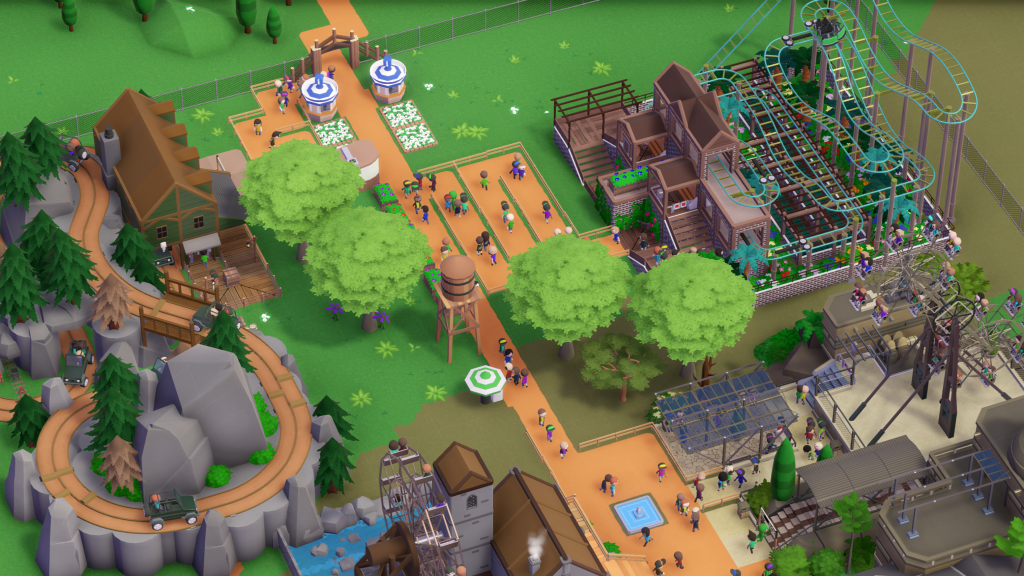
Parkitect: Deluxe Edition is extremely easy to pour countless hours into, planning and crafting the ultimate theme park – right down to the colour of the staff uniforms and other minute details. Creating a successful park requires a business-focused mind too, carefully examining the wealth of stats provided to maximise profits. Even after putting in several hours and completing a handful of campaign missions, it still has the capacity to surprise with thoughtful touches and its acute attention to detail, and new rides were still being unlocked dozens of hours in.
It isn’t much to look at compared to Planet Coaster and Park Beyond – with the visitors themselves remarkably crude – but it’s definitely a richer experience for being far more grounded in reality. Without a doubt, it washes away the stench left by the dismal RollerCoaster Tycoon Adventures Deluxe.
Texel Raptor’s Parkitect: Deluxe Edition is out now on PlayStation and Xbox formats. Published by BlitWorks. A PC version is also available.