
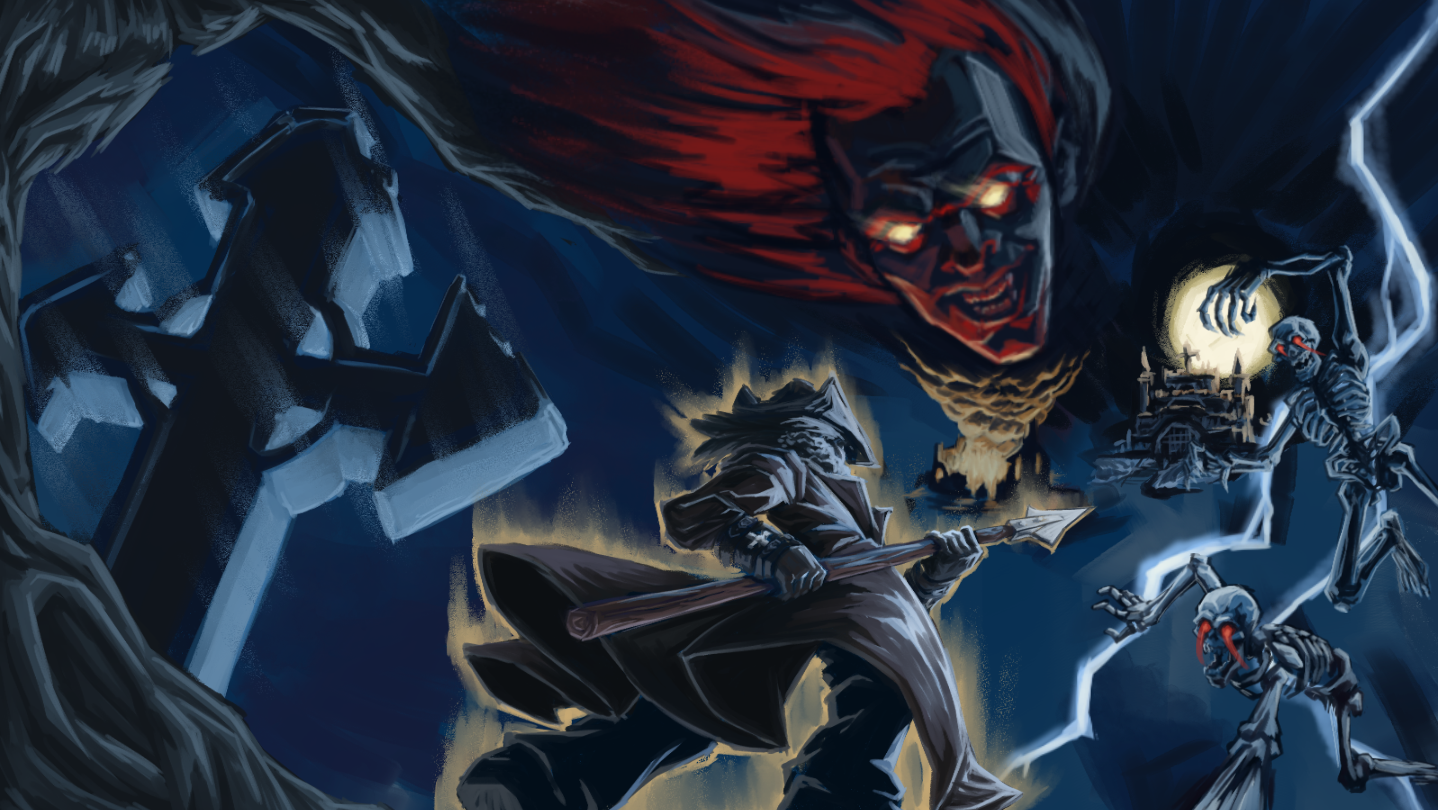
Much like 2024’s puzzle platformer The Meating, this side-scrolling action game resembles a NES classic of yore, but isn’t something that could have existed during the NES’ heyday. This isn’t so much to do with looking and playing like a NES game on steroids – with numerous sprites on screen at once, fast action, and richly detailed backdrops – but rather its buckets of gore. It’s gloriously grotesque, not just boasting enemies that explode into meaty chunks but also a stage set in a torture chamber with interactive guillotines and more. Good ol’ family friendly Nintendo wouldn’t have liked this one bit in the ‘80s. Or the ‘90s, for that matter.
Set in 1698, Saint Slayer: Spear of Sacrilege is clearly born out of a passion for Konami’s 8-bit Castlevania games, even mimicking their fixed-movement jumping arc. It isn’t a brazen clone of Castlevania, however. Far from it, as it sets out to carve its own identity, while also being full of unique traps to catch seasoned players unaware. Even if you’ve finished the NES Castlevania trilogy countless times, you’ll doubtlessly find that Saint Slayer will develop and test an all-new set of skills. It’s the kind of experience where even if you die foolishly, you will have learned something to prevent making that same mistake again.
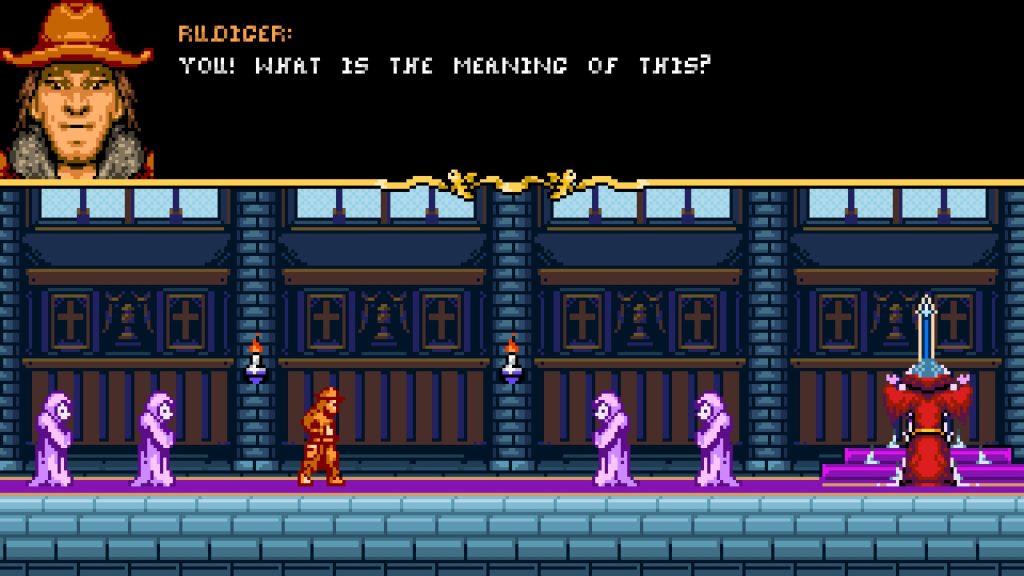
As the name suggests, our hero – an ex-soldier known as Rudiger – carries a sharp, long reaching, spear. Or to be more exact, this is their reward after first encountering a zealous priest, having to make do with a knife until that point. The spear can be launched into walls to create a makeshift platform, and can be thrown at enemies a limited number of times, with this action governed by a gauge. By defeating bosses, it can be enhanced too, including a charged attack that breaks large boxes, and the ability to pogo bounce on enemies, recalling Shovel Knight and (more appropriately for the era) Capcom’s DuckTales. This isn’t just used to defeat enemies but also to traverse spike pits and other hazards.
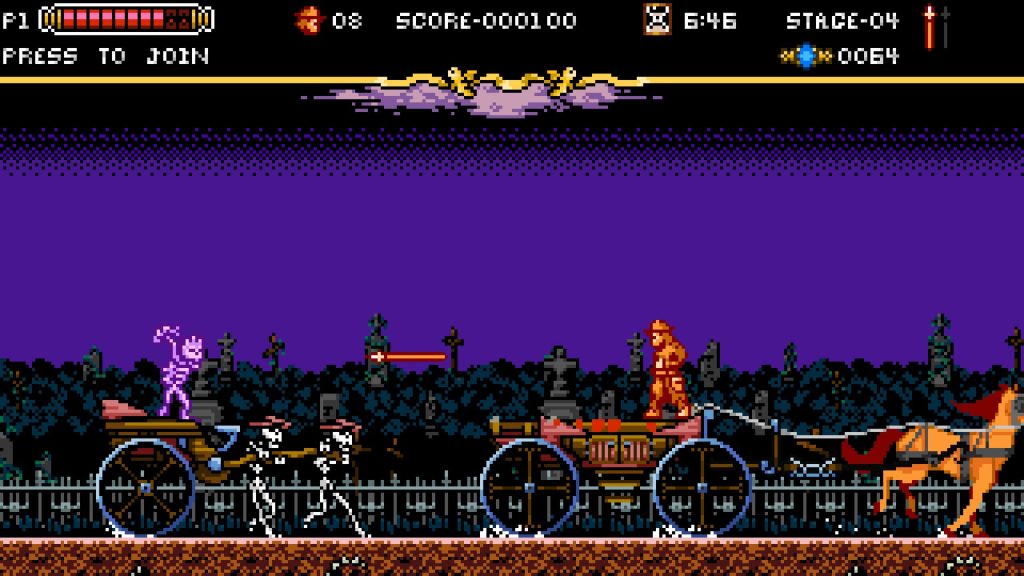
The first couple of stages are par for the course, allowing you to get to grips with the controls and fixed-arc jumping, while giving a mild taster of the typical challenges to come. Just over twenty stages feature in total, with some being larger and more involving than others. There’s a horse and cart vehicle section early on, a jaunt across a river using a boat, a two-tiered stage with elevators, and a rotating tower to frantically climb. No stage has a filler-like feel, as each introduces something new while putting newly acquired skills into play.
A couple of stages struck me as more difficult than the rest though. The torture chamber has random 30 second ambushes and a higher enemy quota overall, while also introducing branching paths via a choice of doors to enter. Then there’s the library stage, which has pesky small floating books to avoid and toppling bookcases to cautiously trigger before backing away. Together with the usual assortment of knights, ghouls and swooping crows, every screen in the library is bustling with enemies. Stages with pits are the most challenging of all, as one poorly timed jump will cost you a life and put you back to the start of a stage. The lack of checkpoints isn’t an oversight, mind, but rather the way Saint Slayer has been designed, encouraging you to learn a level and its dangers wholly to progress. It’s a lot more satisfying as a result.
It’s clearly designed to test the skills of those who mastered the best of the NES, and it does so in a few different ways. There’s a lot to learn about its enemies, including which can respawn, identifying the hazards some leave behind, and their general attack patterns. Bosses too have patterns to memorise, as well as tricks to use against them – such as boxes that can be dropped, in one instance. It’ll throw you a bone every so often – such as a valuable extra life, or a major health pick-up – but even so, caution must be exercised. See, power-ups and health restoring food can be accidentally destroyed – something you’ll likely make you curse. On top of this, there’s rotten food to avoid, which will make poor Rudiger puke his guts up if accidentally eaten.
Incidentally, Rudiger’s remains…remain in place when replaying a stage, even rotting over time. As well as a fun (if gross) touch, this is a pretty good indicator of showing where things went wrong last time, ergo where you may need to use more caution. Similar fun touches are common, making it clear that the developers put their heart and soul into this project, going overboard with idle animations, collectable familiars, and secrets most players probably won’t discover until their second or third playthrough. Pro tip: Talk to the shopkeeper every encounter.
Getting back to the subject of difficulty, Saint Slayer: Spear of Sacrilege has a few different options. Easy mode omits knockback and grants a generous amount of lives, presenting a stiff yet manageable challenge. Some bosses can be ‘cheesed’ by getting up close with a fully charged spear, and using all three spear throws proficiently can cause a significant amount of damage too. Normal mode has more enemies than easy mode and grants fewer lives and less HP. Hard mode reduces lives and health further, while classic mode removes the shop and grants no continues. On that note, orbs are required to continue elsewhere, usually found inside walls or in higher areas. There’s a password system to continue as well, which ties not just into the old skool vibe, but is also there to access a bunch of secret stuff linked to glowing treasures found in each stage. You’ll need to figure out how to reach some of these, adding another layer of depth and challenge.
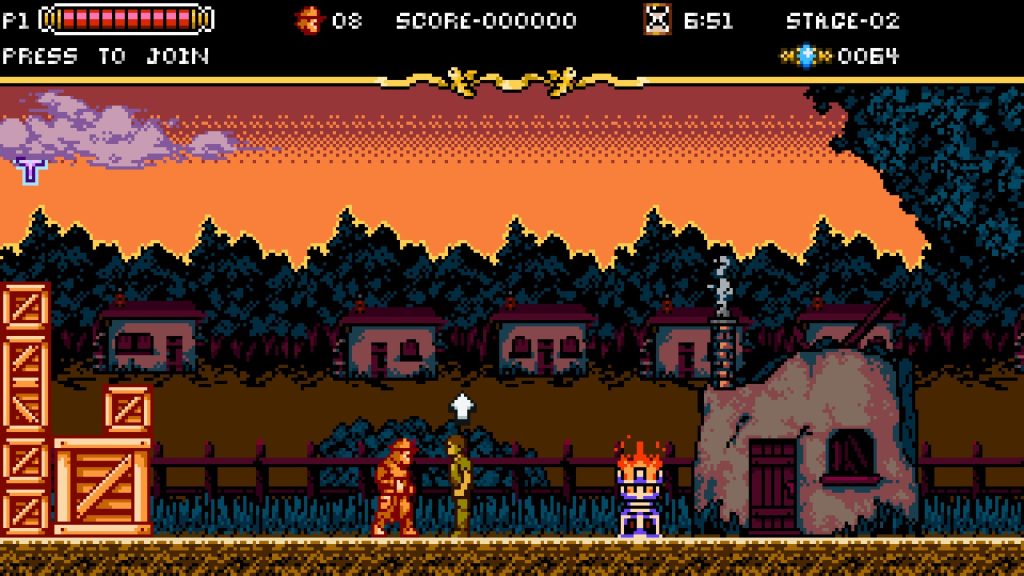
The presentation is pleasing overall. It borrows a few traits from the NES to give it an unmistakable look, such as sprites that only use a couple of colours. The action is a lot faster and smoother than a genuine NES game, while pixel art is more intricate – right down to piles of squishable poop in the sewer. The chiptune music is a mixture of upbeat tunes to spur players on and downbeat melodies to create a sense of dread and despair. A couple of tracks did become monotonous though, playing on short loops.
Saint Slayer: Spear of Sacrilege isn’t something you’ll beat in a single sitting, but rather over a couple of sessions, enduring and eventually overcoming its pesky difficulty spikes, and perhaps being caught off guard by a boss fight or two. It never allows you to become complacent for long. To see everything, you’ll need to replay it numerous times, not just on different difficulties but with treasures equipped. There are different endings to discover, and a few bonus challenges to consider, such as avoiding killing any innocent citizens – a task easier said than done. Every playthrough will result in learning something new, bestowing a new level of appreciation.
It’s an experience layered like an onion, with a unique flavour to savour that can be overpowering at times. Even its flaws are in some way distinct, being deliberate rather than oversights, making for something that’ll please discerning palates but maybe not everyone.
Lillymo Games’ Saint Slayer: Spear of Sacrilege is out 20th April on all formats.