

Like a Fry’s Turkish Delight, this arid desert-set adventure is full of eastern promise. We’re introduced to Nadira and her faithful pet lizard Jiji, who must brave hostile deserts in search of a lost princess rumoured to grant wishes. While a fantasy adventure foremost, it cleverly manages to edge into sci-fi territory too. Just like biting into a chocolate smothered Turkish Delight, though, Mirage 7 is something for those with a very discerning palate.
Featuring a third-person perspective, it begins with a tutorial loosely centred around desert survival, with Nadira hastily gathering items essential for the journey ahead. This includes a flint for striking fires, a canteen – which will restore health upon consuming single use ‘water flowers’ – and a trusty dagger. You’ll also get to control Jiji for a while, who can squeeze into cracks, fend off scorpions, and most importantly activate a ‘lizard view’ that highlights all interactable and collectable objects. This colour-saturated view is essential to use within each new location, later revealing hidden symbols used within puzzle solving.
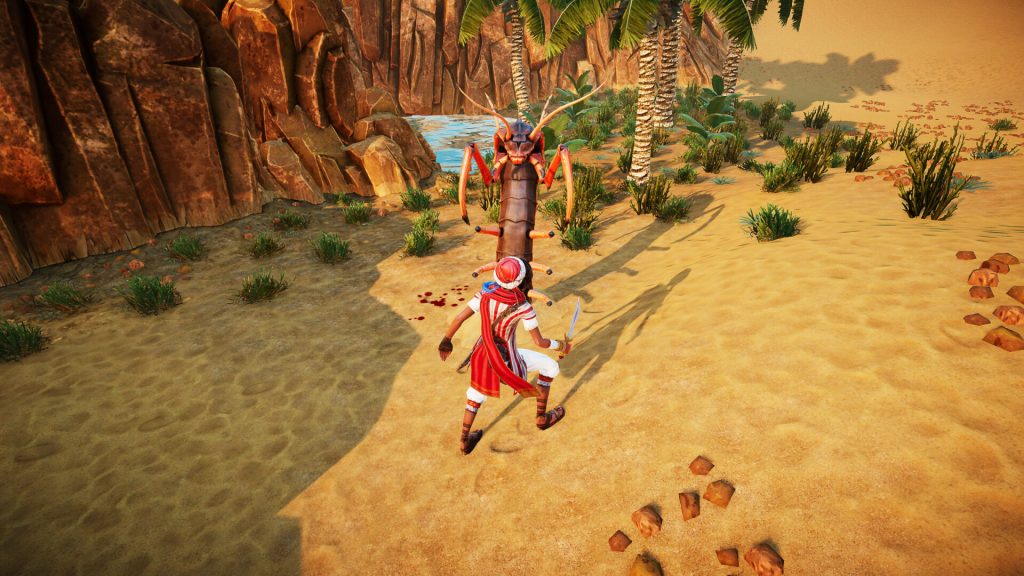
Then comes the combat tutorial…which single handedly makes Mirage 7 feel akin to a PS3 era throwback rather than something contemporary. Melee combat is painfully clunky, complete with an auto lock-on that doesn’t always play ball, a roll manoeuvre that irksomely flips the camera around, and animation far from flamboyant. Nadira can withstand 3-4 hits, and most enemies require the same amount. It’s very much a case of dodging the single attack each enemy possesses before waiting for the opportunity to strike. When pitted against a single foe, this is fine. Manageable, at least. Go up against two enemies, and it then becomes an awkward case of backing away in a bid to separate them – something that often leaves Nadira vulnerable.
Amazingly, this isn’t too damaging to the experience as a whole. See, Mirage 7 isn’t a combat focused adventure – it leans heavily on puzzle solving instead. Once this combat tutorial is out of the way, there’s just a brief cave-based section to endure before Nadira gains a slingshot, used not just to strike enemies from afar but also to hit switches. From this point onwards, the slingshot can be used instead of the dagger, bypassing all the flaws of the melee combat system. Stones (used as ammo) are commonly found, and slingshot hits are just as powerful as dagger swipes. Just to further highlight how secondary combat is, there are only four different enemy types – two of which are roaming spectres – and no boss battles feature.
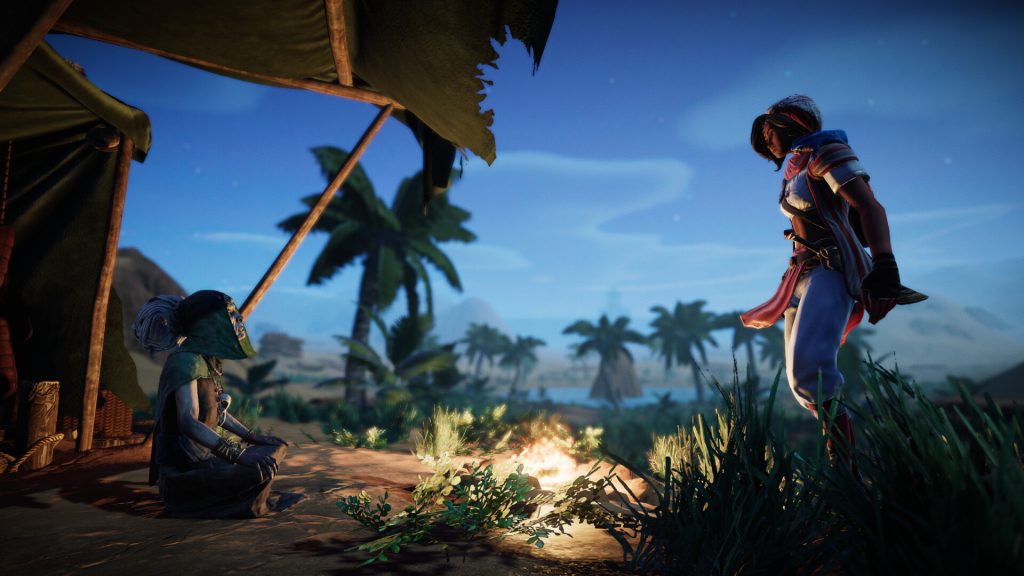
To hammer home how heavily Mirage 7 is centred around puzzle solving, around two hours in a grand temple is reached. Upon setting foot in here – after figuring out the multiple steps needed to unlock the door – you aren’t going to be leaving this place for another couple of hours. This temple is formed from several rooms and spread across two floors, with each room having a unique puzzle to solve. Puzzle components are scattered around, and it isn’t always immediately apparent which component is used where. Adding an extra layer, items can be both combined and broken down within the inventory. Removing some figurative head scratching, Nardia will chime in with a tip if you linger in a room for a while. I became stuck a couple of times, once while overlooking a hidden key that only Jiji can collect, and later while trying to place an item on a statue. Turns out a table must be pushed against the statue first, so you can jump onto it to reach the statue’s hand. I wouldn’t be surprised if other players overlook that extra necessary step.
The variety of puzzles is pretty good – one of the stronger points, in fact – including tilting and moving mirrors to direct beams, gathering items to re-create scenes shown on a tapestry, finding and shooting targets before they vanish, and melting/grinding/crushing various materials to use in crafting. Later, Nardia finds a musical instrument, which requires glowing notes to be found within the environments and played correctly, resulting in a test of memorisation skills.
The game’s second half relocates to a desert at night, tasking Nardia with finding ingredients required to make moon cakes and date tea to appease an NPC, before presenting a rather tedious quest to find music notes spread across the entire desert. From here, we’re then ushered into a second expansive temple for another round of multifaceted puzzle solving, this time in search of keys. Without wanting to spoil things, it’s also here that the adventure ends rather abruptly, with no boss fight or one last grand puzzle to round things off.
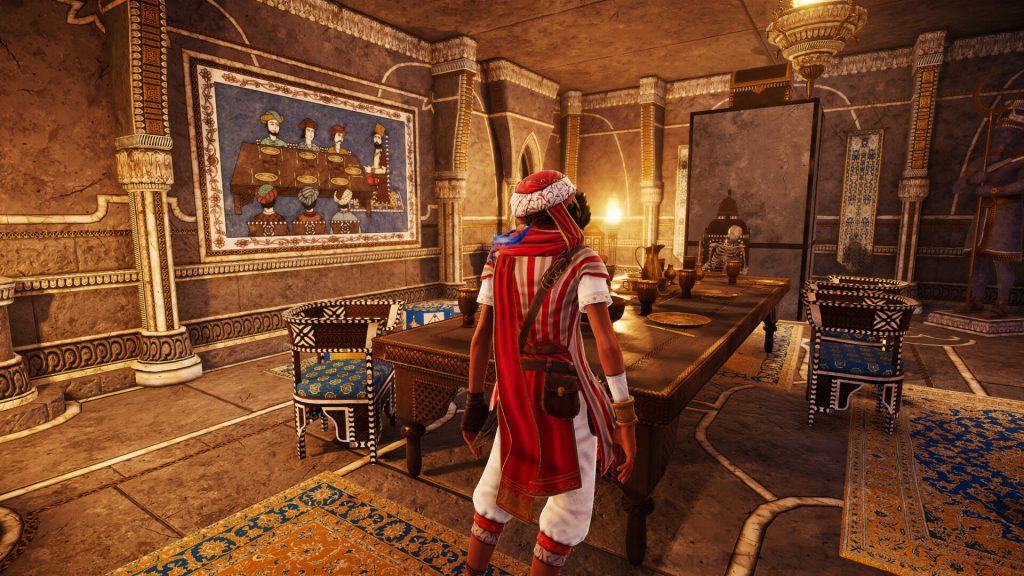
Mirage 7 falls into a peculiar niche, seemingly designed for those who enjoy the kind of puzzles in modern era Zelda and Tomb Raider but aren’t interested in combat whatsoever. As Nadia outlines her plans from the outset there isn’t all that much in the way of surprises, simply travelling from one puzzle-filled location to the next. The story is more of a means of propelling things along, rather than forming a gripping narrative. Collectable scrolls help to expand the lore, though, and Nadia herself is instantly likeable, headstrong and determined.
This is something that has clearly been made with the best intentions, but feels weirdly behind the times, as if it could have existed in its entirety towards the end of the PS3/Xbox 360 generation. At a time when budgets are spiralling out of control, it is perhaps understandable why a developer would want, or maybe even need, to dial things back a generation or two. Perhaps there is even an audience for throwback third-person solo adventures. Nevertheless, there are plenty of puzzles to solve throughout Nadia’s quest, and although the solutions aren’t always entirely logical, it will give your mind a reasonable workout. Those looking for action should try the similarly themed Blood of Mehran, from the same publisher, instead.
Drakkar Dev’s Mirage 7 is out 6th March on PS5, PS4, Xbox Series, Xbox One and PC. Published by Blowfish Studios.