
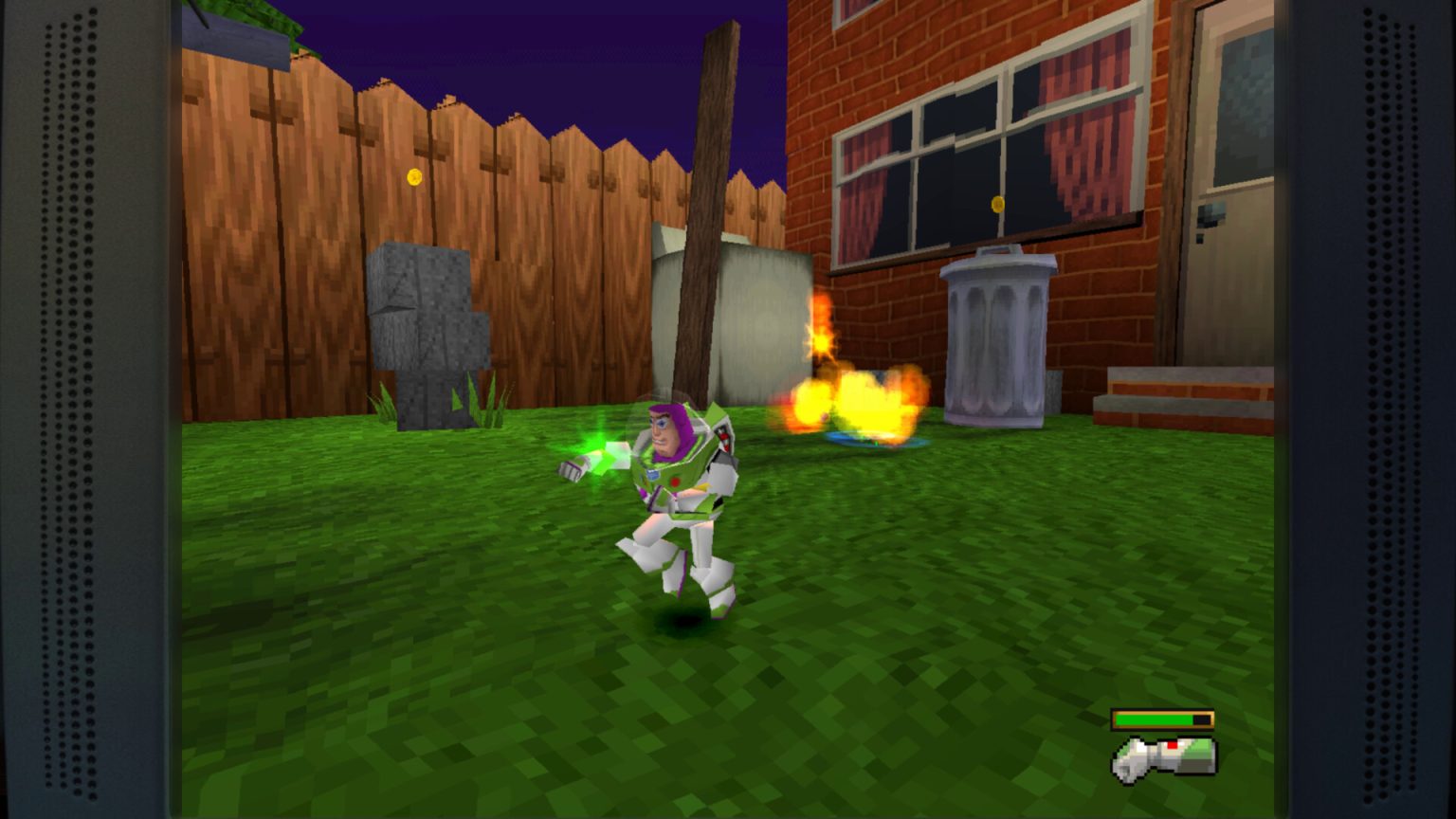
When it came to Disney’s tie-in games, the priority was always to release them on formats children could access, rather than on the most powerful hardware. That’s why this retro collection begins in 1995 with a couple of late releases for the Mega Drive and SNES and ends with a late-2001 PS1 game. In both instances, more powerful hardware was available – it just wasn’t beneficial to release a Disney game on those formats at the time. There are a bunch of Game Boy games here too, offering wildly mixed experiences. Some are interesting; others less so.
The Mega Drive and SNES versions of Toy Story are reasonably similar, although the SNES version has more colours and lacks a racing stage. The Mega Drive version launched on the same day as the movie and, reportedly, was the first movie tie-in ever to do so, while the SNES version trailed by a few weeks. These are 2D platformers with rendered visuals that frequently mix up the gameplay, shifting from side-scrolling platforming to top-down racing and even a first-person maze. The platforming sections have objectives and aren’t simply a matter of scrolling to the right—something surprising to see in a children’s game. Saturn title Clockwork Knight provided inspiration here, and Traveller’s Tales managed to make the humble Mega Drive pull off faux 3D, giving the backgrounds the illusion of depth. These two games are technical marvels, with the Mega Drive version slightly more so, and they remain historically important. This was the game that convinced SEGA to let Traveller’s Tales make Sonic 3D Blast, after all. They follow the movie closely too, which is always important in a tie-in.

The Game Boy version from 1996 is also here. Amazingly, it uses the same sprites as the Mega Drive adaptation, only shrunken down. It also attempts to recreate the majority of the stages, although it’s far scrappier and more sluggish. There are no stills during cutscenes, and the music is ear-gratingly shrill. Still, for a Game Boy game, it is quite impressive to see rendered renditions of Woody and Buzz running around and performing the same actions as their 16-bit counterparts.
The next stop in this retro collection isn’t Toy Story 2. It’s A Bug’s Life on PS1 and Game Boy Color – the latter being backwards-compatible with the original Game Boy. This was Traveller’s Tales’ first-ever 3D platformer, and you can tell the team struggled. The camera system is beyond poor; it’s almost nauseating, constantly moving around as it attempts to follow the action. Again, the game follows the plot well and, thanks to CD storage, includes short clips from the movie. There’s a sprinkling of originality too, as you collect seeds and their corresponding upgrade tokens to create platforms, stronger projectiles, dandelions to glide with and pod thrusters to reach higher areas. None of this is explained well, though – there’s a curious lack of tutorials and prompts throughout – making it oddly challenging for a children’s game. I even had to consult a guide for one section. Visually, the textures are sharper than before, yet the pop-up remains. Even bosses have a tendency to vanish from view if you stray too far.

The Game Boy Color version is the epitome of a lazy tie-in: a generic platformer with poor hit detection and stiff controls. It was such an early GBC release that it’s believed most players experienced it in black and white, having not yet upgraded. Incidentally, most of the handheld games featured here were made by the UK-based Tiertex. It seems that, after creating a bunch of middling arcade conversions for the C64 and ZX Spectrum in the ’80s the studio became the go-to developer for licensed handheld games in the ’90s and noughties. They really couldn’t get away from the Zilog Z80 processor. This did, at least, lend the team some technical expertise.
For Toy Story 2, Traveller’s Tales turned to Nintendo’s world to see what Super Mario was up to. The result is a 3D platformer remarkably similar to Super Mario 64, from the way it looks to the way it plays. Thankfully, it has a better camera system than A Bug’s Life. You play as Buzz and must explore surprisingly open environments in search of tokens that unlock new areas. They can be acquired through platforming, mini-boss encounters and activities such as races. While Spyro was a better attempt at bringing 3D platforming to the PS1, this isn’t bad at all, considering it also had to follow the beats of the movie. The Game Boy Color version doesn’t feature rendered sprites as before, but instead uses crudely drawn, cartoony versions of the cast. It’s objective-based again and suffers from control issues. It’s strange how closely this resembles an 8-bit microcomputer game compared with its predecessor.

Traveller’s Tales was also behind Buzz Lightyear of Star Command from 2000, based on a cartoon series that Disney allegedly doesn’t reference much nowadays. This isn’t a 3D platformer. Instead, it’s a shoot-’em-up with a racing element: you must chase a villain through themed stages while shooting enemies and purchasing weapons on the fly with credits collected along the way. If you’re able to keep up, the stage ends in a shoot-out-style boss fight. The visuals are colourful and cel-shaded, and the engine copes well with the number of projectiles being flung around at once. It’s not a classic, but it isn’t too bad either – and, due to its obscurity, it might be new to many. The Game Boy Color version follows the same rules, but plays more like an NES shooter – think Commando or Ikari Warriors. It doesn’t look much better than an early NES game either; for a 2000 release, you’d expect something more impressive.
This collection ends with 2001’s Toy Story Racer. Presumably, publisher Activision wanted to keep the lucrative Toy Story bandwagon rolling. Cast aside expectations of a Mario Kart rip-off, as this plays and controls differently. I would even say it isn’t a kart racer, but rather an RC racer similar to Re-Volt and Buggy on PS1, as the vehicles mimic the physics of radio-controlled cars, complete with a dynamic camera that shifts left and right when sliding. It isn’t a stock ‘win four races to earn a cup trophy’ racer either – every character has a number of challenges specific to them. As you make headway, more characters unlock and, therefore, more challenges become available. This means you switch between racers often rather than sticking with a favourite. As a late PS1 release, it looks great – a culmination of everything Traveller’s Tales had learned up to that point. The 2D portraits are a little off-brand, mind.
The Game Boy Color version, would you believe, is also a culmination of technical prowess. Tiertex not only managed to produce FMV clips on the humble GBC, but also got them running in the background during gameplay. The backdrops are rendered footage played on a loop, speeding up and slowing down accordingly, with the sprites merely overlaid. It still looks pretty neat today, and the game itself is reasonably challenging, even if the handling is basic. It’s a neat little artefact from the past that may surprise you if you’re unfamiliar with it.
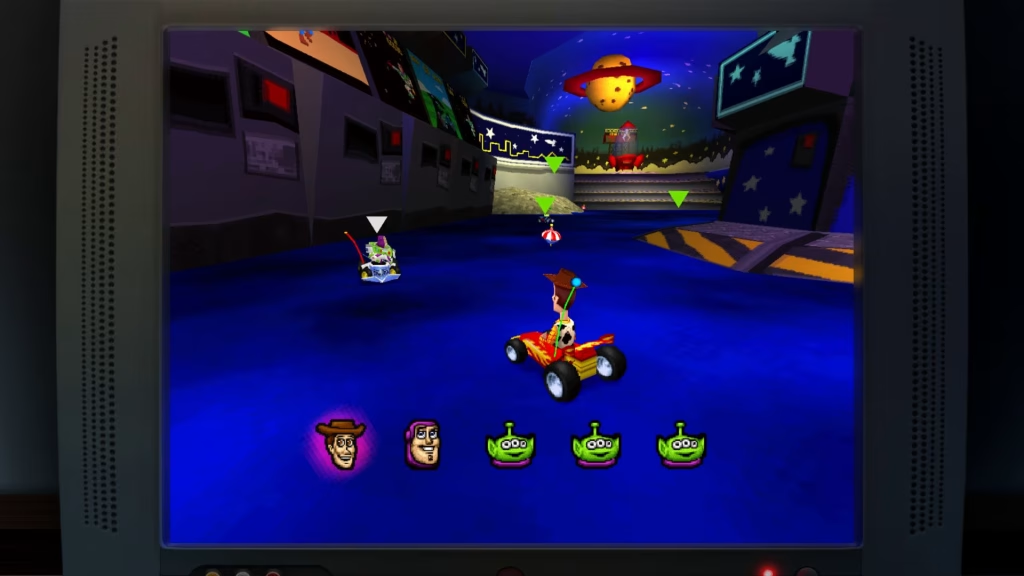
Indeed, I think people will be surprised by how well the PS1’s Toy Story 2 and Toy Story Racer hold up. You may find the original Toy Story enjoyable too, especially if you appreciate what the developers were able to achieve. Your mileage with the PS1 versions of A Bug’s Life and Buzz Lightyear of Star Command is going to vary. You can see what the developers were aiming for with the former, but time constraints presumably hindered them. The handheld games are interesting in their own ways, with the GBC rendition of A Bug’s Life being the outlier. That one is a stinker.
Just like Digital Eclipse’s past collections, the presentation is lavish throughout, with stylish menus and plenty of options and histories for each game, complete with scans of design documents and rotatable 3D boxes. You can save anywhere, rewind, activate cheats (which disable trophies and achievements) and skip to certain levels to practise.
There are five documentary-style interviews too, each lasting around ten minutes. These include a chat with Traveller’s Tales’ Jon Burton about how the Mega Drive was able to perform faux 3D, the evolution from cartridges to the CD format, a look at the constraints faced by handheld programmers, and an introduction to Traveller’s Tales as a whole – including why Disney picked the studio in the first place. One thing you won’t see mentioned anywhere is are Dreamcast and N64 versions of Toy Story 2, which were superior to the PS1 version but are absent here. Most people played these games on PS1, and when you’re dealing with a collection that trades on nostalgia, you have to include the versions with which most people are familiar. It always comes back to finding and appeasing the biggest demographic.
Digital Eclipse’s Toy Story Retro Round-Up is out now on all formats. Published by Atari. Original games by Traveller’s Tales and Tiertex.