
The Amiga computer line had a lifecycle nothing short of turbulent. Despite the original model outclassing its competitors in 1987, quality software was slow to emerge. Then came the threat of piracy, the rise of Windows-compatible PCs, the arrival of the Mega Drive and later the SNES, the advent of DOOM and its sequel in 1993, and finally the triple threat of Windows 95, CD-based 32-bit consoles, and financial woes at Commodore.
Yet, several publishers were able to ride the storm and capitalise on the loyal user base, making a name for themselves by bringing a steady flow of quality software to the system. This included Team17, who found success with Alien Breed, leading it to become one of the Amiga’s most recognisable franchises alongside the likes of Sensible Soccer, Worms and Lemmings.
Team17 released six Alien Breed games on the Amiga, starting in 1991 when the computer was arguably in its prime, and ending in 1996 – a time when most gamers had either moved across to PC or bought a shiny new PlayStation. This collection gives the chance to play all six, proving to be historically fascinating, with the first game able to run on a humble unexpanded Amiga 500 and the final release requiring a hefty 4MB upgrade, meaning even the Amiga 1200 from 1992 couldn’t run it out of the box. There’s also the small matter of the franchise switching genres, going from a top-down shooter to first-person to follow trends.
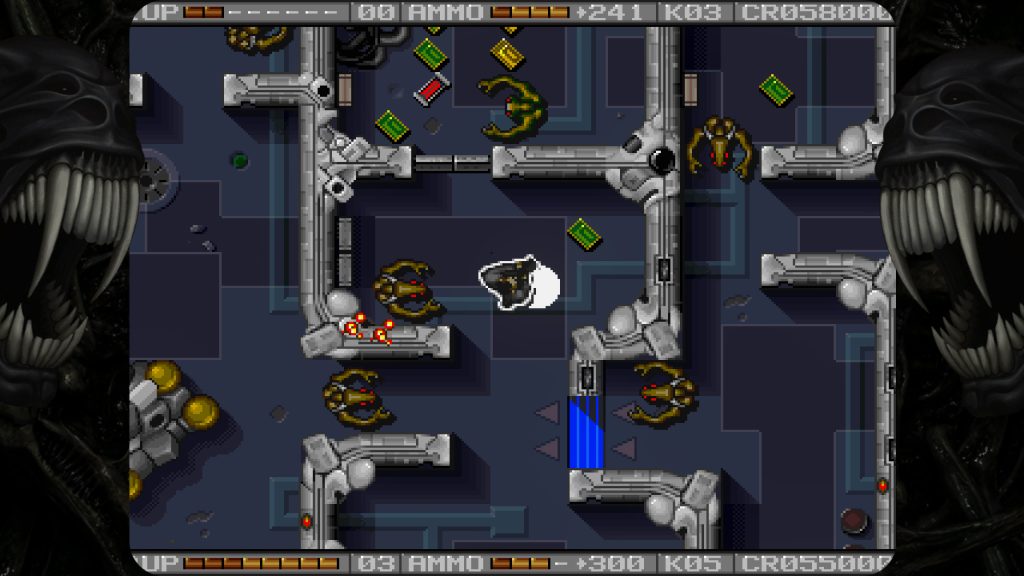
Alien Breed (1991), the visually enhanced Alien Breed: Special Edition (1992), Alien Breed II: The Horror Continues (1993), and Alien Breed: Tower Assault (1994) are viewed from top-down and feature new twin-stick shooting controls. Included are a mixture of Amiga 500 and Amiga 1200 (AGA) versions, plus the CD32 version of Tower Assault – which has FMV intros and outros.
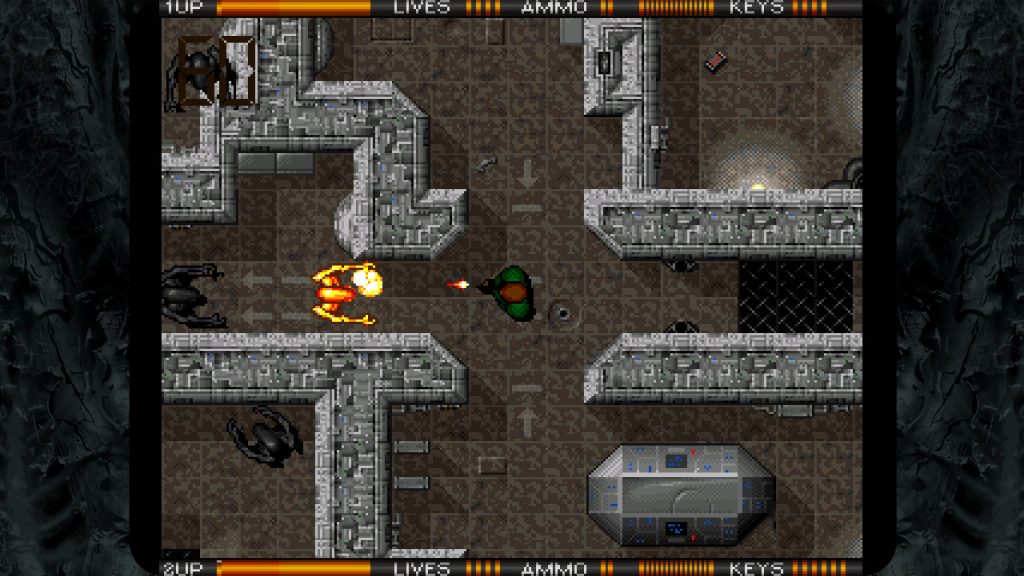
All four have a lot in common with the seminal Gauntlet, seeing you up against waves of respawning enemies, and focusing on collecting keycards, ammo and cash while you navigate cramped maze-like environments. Keycards aren’t used to unlock specific doors, but rather any locked door – meaning you must sometimes choose between unlocking rooms full of goodies or making a swift exit before aliens close in. Computer terminals can also be accessed to purchase new weapons, ammo, bunches of keys, and even extra lives – with all four games having an arcade-like feel despite their tense atmosphere.
The first three games are notorious for being difficult, featuring both a learning curve and an awkward combo of limited ammo and enemies that respawn. By the time Tower Assault rolled around, Team17 finally took note of feedback and made improvements, including a map available from the outset and the ability to backtrack (retreat) while shooting. Save states make them more palatable nowadays, and it’s possible to enter passwords. Still, anyone going into these four would be wise to keep in mind that they were intended to take players weeks to complete, rather than just a few hours. I’m a staunch believer that it’s possible to end up in a ‘no win’ situation too by using keys frivolously, resulting in the need to quit and restart a level.
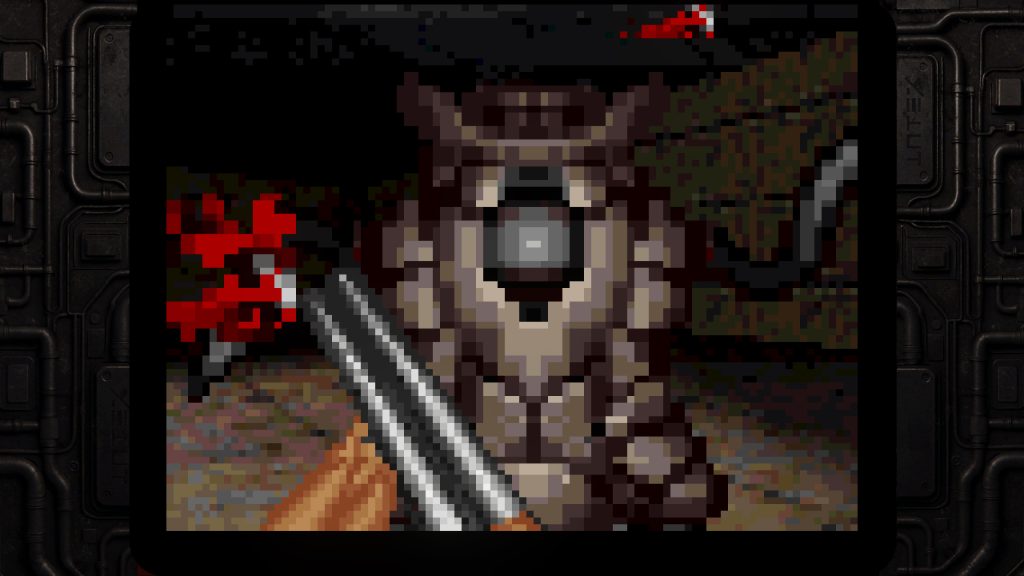
1995’s Alien Breed 3D, as the name suggests, saw the franchise attempt to take on DOOM by being set in first person. Charitably, it could be likened to DOOM on the SNES in terms of prowess. More accurately, it’s like playing DOOM through shattered glass due to heavy pixelation. For Amiga owners back in 1995, this was like SNES owners seeing Star Fox or, well, DOOM, for the first time – something far beyond what their system was believed to be capable of. It controls well, and it’s quite speedy too. The screen can be enlarged, which helps with visual shortcomings, but this removes essential parts of the UI. If you’re looking for a challenge, you’ll find one here; partly through its tricky and occasionally puzzling level design, and partly through its technical anguishes. It’s definitely one of the more interesting games present, showing how Amiga developers were trying to keep up with trends while contending with limited hardware. The demo versions are here too, which alter greatly from the final product.
This brings us to Alien Breed 3D II: The Killing Grounds, a 1996 release that many Amiga owners feverishly anticipated, believing that it would prove the system had a future. After several delays, The Killing Grounds arrived demanding either 2MB or 4MB of RAM, with the 2MB version being visually inferior. To put this more into context, Amiga owners had to upgrade their system to play this. The result? It’s a huge step up from its predecessor, more closely resembling an early PS1 game thanks to sharper visuals and vastly improved resolution. It’s more than just a DOOM clone, too, as evidenced by a running dialogue box that details surroundings and predicaments. It does however have a DOOM-style vector map overlay, which helps navigate its more bewildering levels. Just like all five games previously mentioned, this isn’t something you’re going to blitz through in an hour or two, but rather put through its paces by saving and reloading when things go awry – which they almost certainly will.
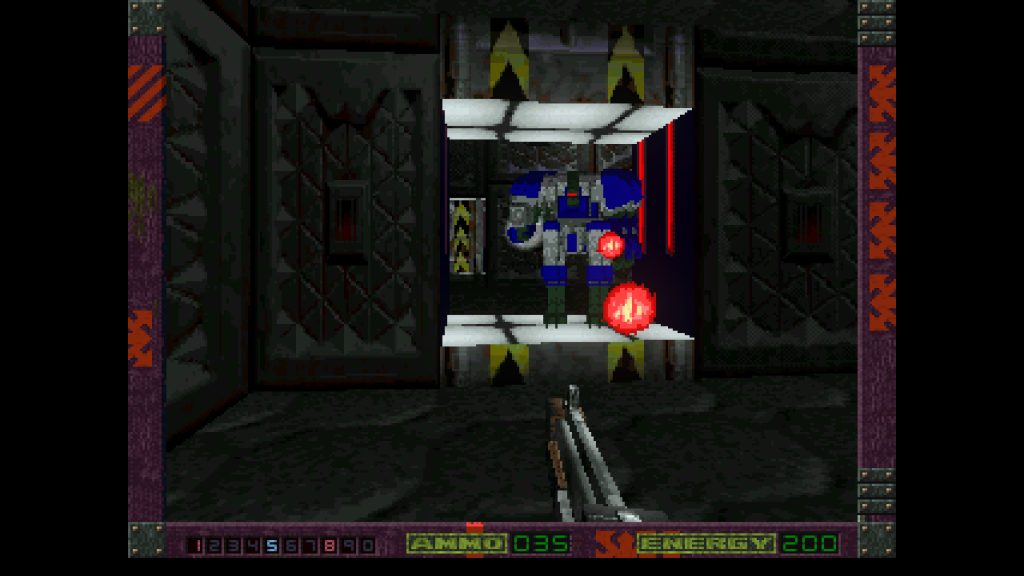
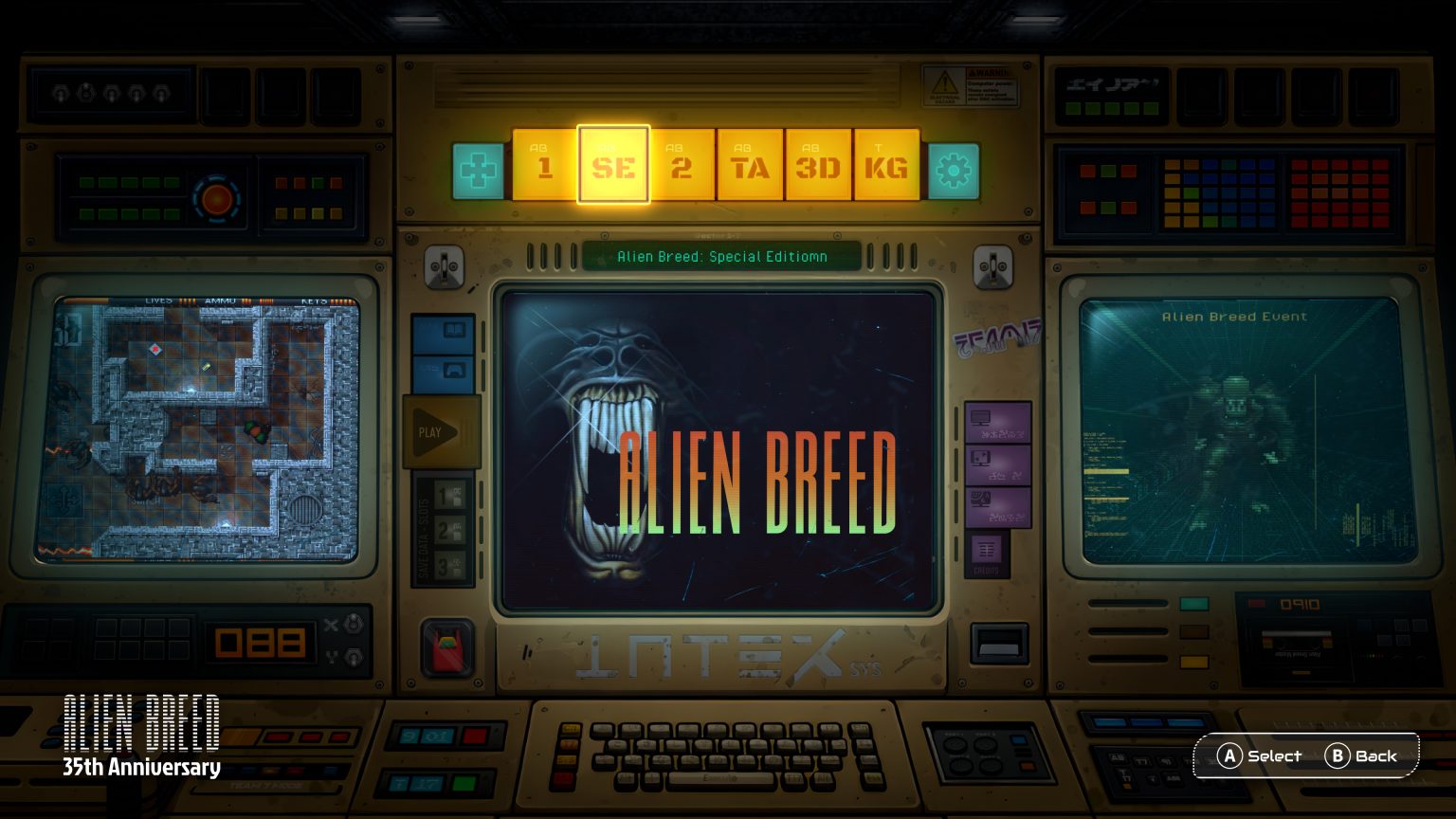
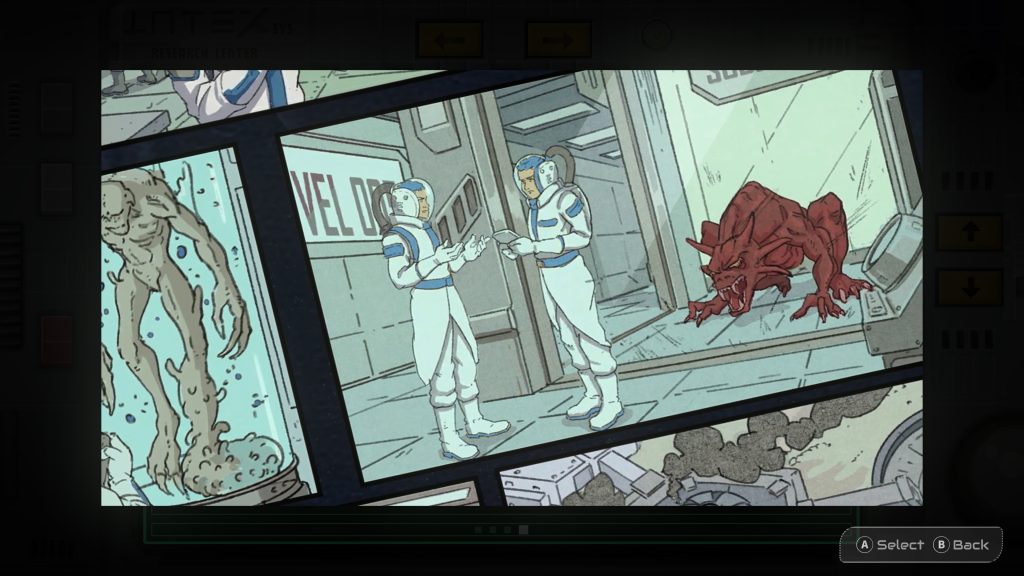
This collection has been put together by Antstream and includes a 3D front end intended to mimic an in-game Intex terminal. Each game has an abridged manual, a breakdown of controls, and the ability to play online using a peer-to-peer service that requires a code to join. CRT filters can also be added, along with bezels. Then there’s the interactive museum, with each game having its own section that includes box art, concept art and more. FMV interviews with the developers and a look at cancelled games are also present, making this feel like a carefully curated experience intended for preservation purposes rather than a bunch of ROMs chucked together for a quick buck.
There’s one thing I couldn’t shake, though, even after spending a week with this collection and dipping in and out of each game (leading to self-inflicted confusion when returning to the top-down endeavours): simply, you may need to be familiar with these games (ergo, owned an Amiga during its heyday) to appreciate this collection fully. Anyone expecting to jump into the top-down games and see their endings within an hour or two, throwing in extra credits to continue, is going to be in for a shock and possible disappointment. All four are edging towards being unfairly challenging, and the only way to even things is to abuse save states.
Alien Breed 3D fares better, although it does take time to become accustomed to the almost comically low-res visuals. This leaves us with The Killing Grounds; a game so late in the Amiga’s life that chances are even some diehards missed out. It has an elusive feel to it; as if it’s something that shouldn’t exist but somehow does. Yes, it’s dated, but also fascinating for multiple reasons – as if the Amiga still had something to prove in 1996, when in reality it should have been left to fade away gracefully, letting games like Lemmings 2 and Worms be its legacy.
Through this collection alone, anyone going in will have a far better understanding of the Amiga, from its strengths to its limitations, taking us from arcade-style shooters to upgrade-demanding first-person experiences. Even beyond this, thanks to the rare inclusion of CD32 games; known for their FMV clips and little else. Any retro fans would do well to broaden their horizons by seeing what this collection can offer, even if it’s merely a new perspective on a system that some would argue never truly died.
Antstream’s Alien Breed 35th Anniversary Collection is out now on PS5, Xbox Series and PC. Published by Commodore. A Switch version is planned for later this year. Original games by Team17.