
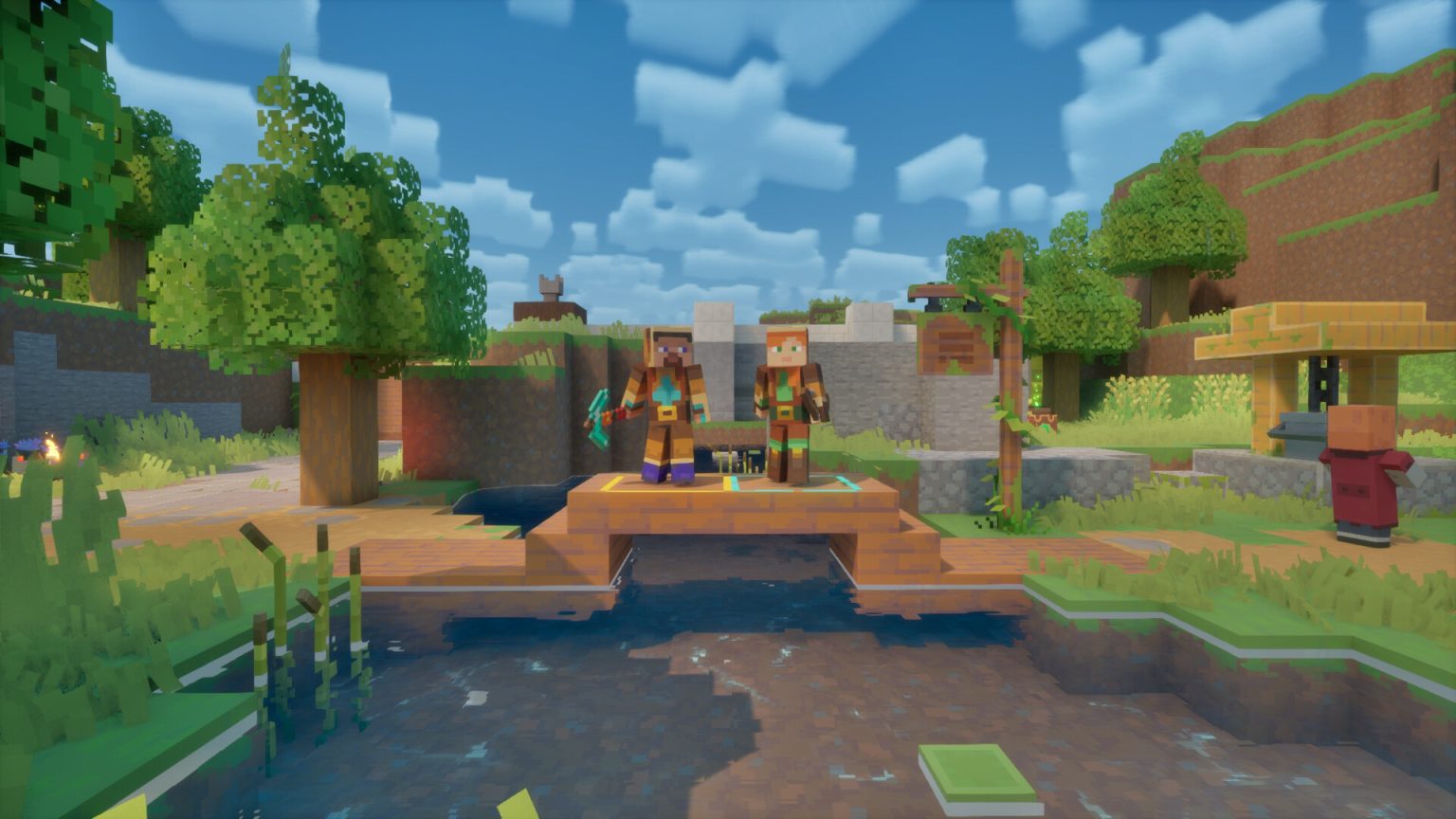
It isn’t hard to imagine Minecraft Dungeons II having a bigger mandate than most projects based on an existing franchise. In addition to the need to adhere to Minecraft lore while implementing enemies and biomes fans will recognise, along with a fresh and suitably heroic world-saving storyline, the developers were clearly tasked with keeping things relatively straightforward and geared towards younger players. Factor in the requirement of a last-generation Switch version, plus the possible need to introduce new elements for future merchandise, and it isn’t difficult to see why this sequel refines rather than innovates.
If you need an example, one of the biggest new features is the ability to jump and perform ground-pound attacks, which we’re pretty sure was one of the selling points of a late-era Skylanders release many moons ago. More significantly, the world is now fully interconnected, with four key locations spread across the overworld, linked together by fast-travel minecarts, alongside another four found within the new Sift underworld. The Sift’s locations tend to blend into one another, largely taking the form of coral-hued environments peppered with inviting yet corrosive pools. There’s also a pleasingly low-key musical theme here, with the Sift’s oddball creatures seemingly conversing through melodies and locations bearing names such as Lullaby Hills.
The newly discovered portal leading to the Sift ties directly into the storyline, with three Illagers (outcast villagers) opening the rift in an attempt to become all-powerful by siphoning the Sift’s magical properties. As a lone hero rising to oppose them, it’s your job to follow their path of destruction, venturing to the furthest reaches of both worlds while completing quests designed to corner the trio of newly self-appointed monarchs. This can be achieved either by playing solo offline, with the difficulty tailored accordingly, or with up to three others online.

Online companions can communicate using pixel-art emojis, and there’s a notable focus on skills that benefit the entire team, such as placing healing totems or using war drums to increase everyone’s critical-hit rate. These are just two examples from a surprisingly lengthy list of support items, and there’s a lot of neat looking gear to show off, including unique weapons.
Things begin in typical RPG fashion, with a one-to-two-hour introduction centred around restoring the humble town of Brave Haven while gradually acquiring a doubtlessly mismatched set of starting armour by completing quests. Brave Haven serves as your hub and the place you return to upon defeat. Three vendors can eventually be established there, with their gradual introduction helping to avoid overwhelming players unfamiliar with the genre.
One shopkeeper deals in weapons and armour, with new stock appearing periodically. Alternatively, shards earned from defeating tougher corrupted enemies can be used to refresh selections. It’s better to reserve them for upgrading vendors to their maximum tier, mind. Items can also be enhanced with new attributes using tokens earned through levelling up, before being taken to the blacksmith to increase their rank. This means that if you become fond of a particular weapon or piece of armour, it’s possible to keep upgrading it rather than watching it become obsolete. Gear follows a familiar colour-coded rarity system reminiscent of Destiny, with high-end equipment typically earned by defeating bosses or reaching the end of dungeons, all of which reward players with obsidian chests.

Incidentally, every location contains at least one optional dungeon to discover, taking roughly five minutes to complete. That estimate rises closer to ten minutes if you choose to engage with the mobs rather than haphazardly leaping and rolling your way to the exit. With exits clearly marked on the mini-map, becoming lost is almost impossible.
Navigation is straightforward across the board. Quests are easy to select and follow, while (optional) glowing trails can lead you directly to your next objective. More often than not, they’ll guide you to a locked gate or door, leaving the nearby key hunt up to the player. Fortunately, keys are usually located less than thirty seconds away.
Fast travel via minecarts is pleasingly swift, with loading times lasting only a few seconds. Even after being sent back to Brave Haven upon defeat, getting back into the action requires minimal fuss, often warping you directly outside a boss arena or key objective. Those quick loading times may well be the payoff for visuals that feel a generation behind the time. An odd lack of spectacle hampers the presentation, resulting in few truly picturesque vistas or dazzling special effects. It definitely favours performance over pizzazz.
Combat is fast and frantic, encouraging equal use of melee and ranged attacks while pushing players towards finding a balanced combination of special items and talismans, three of which can eventually be equipped. Melee damage, ranged attacks, and defensive abilities can all be boosted, while talismans increase health, expand bow quiver capacities, and even provide companions such as dogs or stone golems.

Melee weapons vary wildly, increasing reach and range from heavy strikes to a swift succession of blows. Choices include war hammers, metal talons, dual blades, and an assortment of everyday Minecraft tools. So much for the tagline “Drop the pickaxe, grab a sword” eh?
Ranged weapons take the form of bows with differing firing rates and quiver capacities, with some unleashing three-way shots. Danger can be evaded by rolling, shrewdly mapped to the right analogue stick, while a single health potion is available on a cooldown timer. This creates genuine tension during tougher encounters, as surviving on low health often means desperately avoiding damage while waiting for your potion to recharge.
Periodically, TNT crates appear and, if deployed effectively, can wipe out several enemies in one go. The Enderman also appears surprisingly frequently during the opening hours, terrorising anyone ill-prepared or caught off guard.

It’s clear that mission objectives were designed with co-operative play in mind, as many involve splitting up to retrieve multiple keys or similar items before regrouping to proceed. There are also a handful of escort quests and missions centred on defending or clearing designated areas. None are especially fresh or imaginative, and the overall campaign suffers from a noticeable lack of puzzles, with only one example present. This feels like a missed opportunity to encourage extra teamwork.
Boss encounters similarly fail to ignite the imagination. Among them is a trio of colossal stone golems, all of which rampage around compact square arenas while spewing projectiles. Curiously, I found the first boss more difficult than the second, largely due to a whirlwind attack that repeatedly knocked me out of bounds, eventually forcing a respawn and retry.
Alongside its enjoyable and appropriately tactical combat, the pacing is more than competent, with the journey into the Sift helping to maintain momentum during the later hours. Clearing one main quest immediately unlocks the next, constantly nudging players towards the final confrontation. My playtime reached just over eleven hours, with my character attaining level 50 while standing on the final bosses’ doorstep to clear one last ambush.

The endgame revolves around cleaning up remaining quests, reaching level 100, and tracking down newly emerged soul generators. Interestingly, optional quests tend to be more varied than many of the core campaign missions, which may encourage completionists to stick around and see everything the game has to offer, especially if they’re already devoted Minecraft fans.
Minecraft Dungeons II is a sequel that plays things remarkably safe, prioritising accessibility and instant gratification over innovation. It’s an experience that’s immediately approachable, constantly rewarding players with regular loot drops that ensure their hero is rarely under-equipped for the challenges ahead.
Take away the Minecraft licence, however, and you’re left with a very casual action RPG that offers little that’s genuinely new for genre veterans beyond its delightfully messy combat. Still, it’s difficult to dislike a game that understands its audience so well. For the Minecraft faithful, this is another entertaining trek across familiar locales, packed with co-operative monster slaying and straightforward progression. It may not break new ground, but it confidently delivers exactly what its target audience expects. The developers can put a very big tick in that specific, and undoubtedly mandated, box.
Minecraft Dungeons II is developed by Mojang Studios and Double Eleven. Out 29th Sept on PS5, Xbox Series, Switch, Switch 2, and PC. Published by Xbox Game Studios. A Deluxe Edition is available at retail, including extra DLC.