

The Pokémon series has seen just as many spin-offs as mainline entries, crossing into the puzzle, pinball, fighting and even photography genres. One area untouched by Nintendo and Game Freak is the Survivors-alike auto-shooting genre. The obvious reason behind this is neither wants to be seen as a trend chaser; they’re innovators, not imitators. Here comes The Roots Studio to prove that the Pokémon franchise has the necessary components already in place for a fine Survivors-alike. All that was needed was to ‘evolve’ the genre in some way.
If you’ve played Vampire Survivors or any one of its countless clones, then you’ll have an idea of what to expect here. After choosing a cutesy fantasy critter, each with different elemental alignments, you’re tasked with surviving waves of enemies before taking on a boss that you’ll need to prepare for by levelling up, balancing offence with defence. This is achieved by collecting XP tokens and choosing to improve attack damage, speed, critical rates, health recovery, and special attack cooldowns. Your chosen character can be set to attack automatically, helping you concentrate on avoiding hazards, or can aim manually with the right stick. The only other available action is a dash, which is on a five-second cooldown.
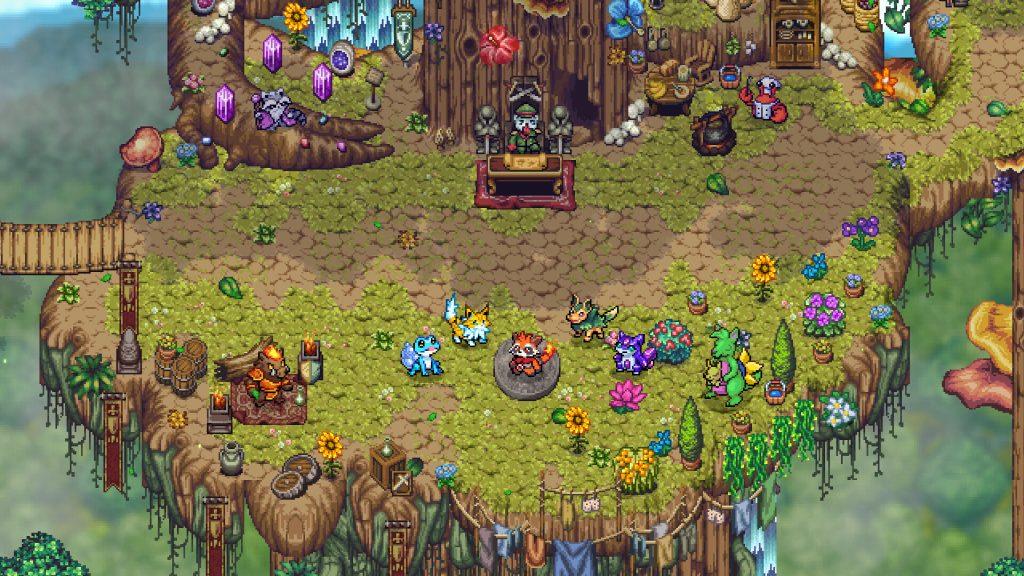
Shard Squad puts its fantasy creatures front and centre, and just like its inspiration, they evolve through use to become bigger and more powerful. Once an evolution is reached through collecting shards, it’s then possible to start with this character, making it a permanent upgrade. It’s also possible to invest in extra starting health, increased XP gain and more by spending currency, with these upgrades being food-themed, and the accompanying vendor found in the small woodland hub area. For some reason, though, I was only able to access the shop once in my playthrough. I assumed they didn’t appear until progress was made, but am now more inclined to believe that their absence was due to a glitch. Regardless, I was able to finish the storyline on the easier difficulty (casual and hard modes are present) without upgrading stats.
It’s also from the hub that a bestiary, additional lore (Shard Squad is surprisingly text-heavy), a local co-op mode, and a cut-scene viewer can be accessed, with the magical realm-saving storyline gradually unfolding.
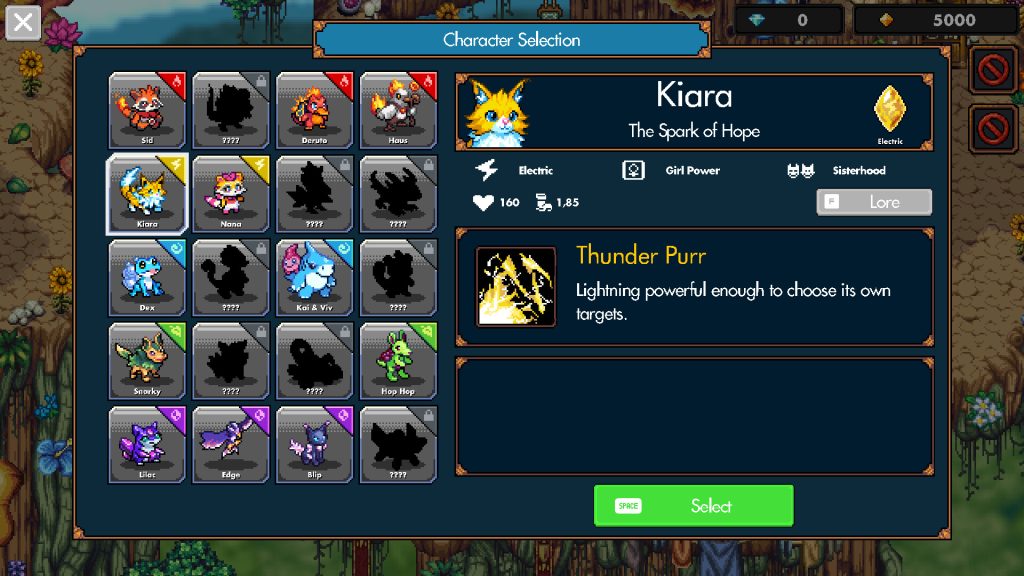
Helping to set Shard Squad apart is the fact that other characters are selectable summons, appearing within the small-scale closed arenas every 10-15 seconds to cause additional damage. One casts a damaging wave of water across the screen, while another spews poisonous pools. In keeping with the elemental theme, there are also lightning strikes, fireballs, and bamboo spikes that appear out of the ground. One character can also conjure music notes that spin around your hero, while another music-themed power-up involves an impromptu electric guitar riff. So, there is a little bit of silliness on display. Bosses, meanwhile, have different attacks from one another, usually dropping health tokens when defeated. Other means of restoring health outside of choosing to regen are few.
Character design is a bit of a mishmash, featuring cartoony animals that aren’t all that different to their real life counterparts – vivid colours notwithstanding – with just a handful showcasing creativity. We developed a fondness for Hop Hop, a green kangaroo. A few bosses are based around puns, but literally just a few. Everything blends well though, helped by the excellent pixel art that far exceeds anything we saw on 16-bit systems back in the day. As mentioned, stages are far smaller here, and this allows for more creativity and set-pieces, doing away with stages that scroll indefinitely. Another positive is the in-game events, which occur every five minutes. These include escort missions, a spot of basketball, 30 second quests to gather objects, and the chance to juggle a football. Stages also have unique elements, such as a cave with poisonous fog and a desert with gusty winds that blow XP tokens out of reach. This helps set them apart.

In addition to looking the part, Shard Squad is pretty well balanced in terms of difficulty, offering a smooth ride with minimal grinding. I noticed a moderate increase in challenge around halfway through – largely due to the small playing area of the island-set stage – and could see how the bullet hell-style final boss could give ill-prepared players trouble. Upon finishing the story, a few bonus stages unlock, and in my case, a wealth of lore remained uncovered. The ability to play co-op may provide additional replay value too. At £5.89, it represents good value for money.
While not a genre innovator, Shard Squad puts a few fun, subtle, twists on the Survivors-alike auto-shooting formula, and through its polished presentation and easy-going nature, it does enough to get by. It’s an easy recommendation to anyone who hasn’t grown sick of the genre yet, especially younger gamers looking for a cutesier take. Had this featured the likes of Pikachu and Bulbasaur, though, you’d probably expect those twists to be far less subtle.
Nuntius’ Shard Squad is out 30th July on all modern formats. Developed by The Roots Studio. A PC version launched in 2025.