
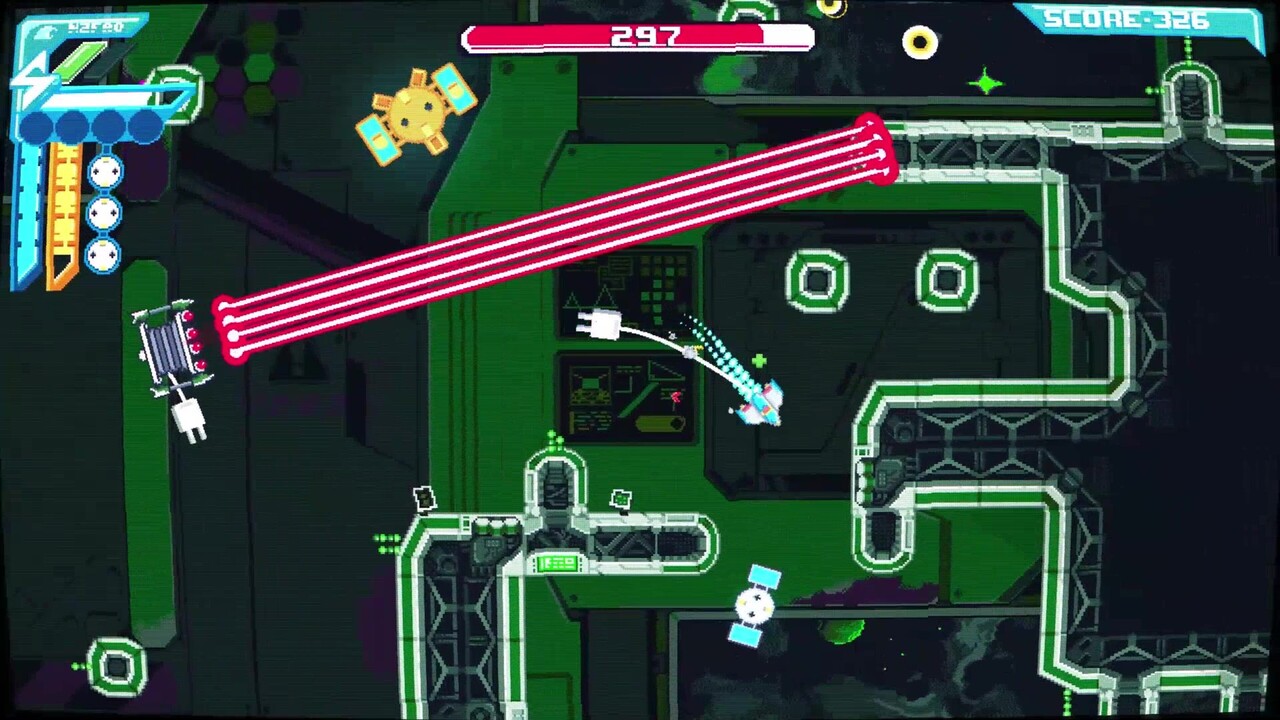
Before wireless tech arrived, we had to make do with wired joypads, forcing us to either sit nearer the TV or pull the console out further, turning it into a trip hazard in the process. Nintendo inadvertently gave us a taste of this simpler time by packaging the NES Classic with short, wired controllers. Now comes the HYPERWIRED, in which being tethered to modules via a short cable is the core mechanic. Forget going back to a simpler time though, as this twin-stick shooter is more complex than most.
You won’t find wireless charging options on HYPERWIRED’s high-tech spacecraft. Connecting to charging ports is their only means of replenishing energy, gaining more ammo, and restocking bombs. Viewed from a top-down perspective, stages are generated randomly and feature four drifting docks to tether to, which greatly reduces manoeuvrability for around 10 seconds. Once all four are connected, the exit opens. While tethered, enemies will either swarm to your position or appear from glowing rifts, at which point it’s essential to launch a bomb or fire a charged laser — one so powerful that it propels your craft backwards. It turns out this can be used as a last resort to propel yourself to a charging dock, should your energy reserves run dry.
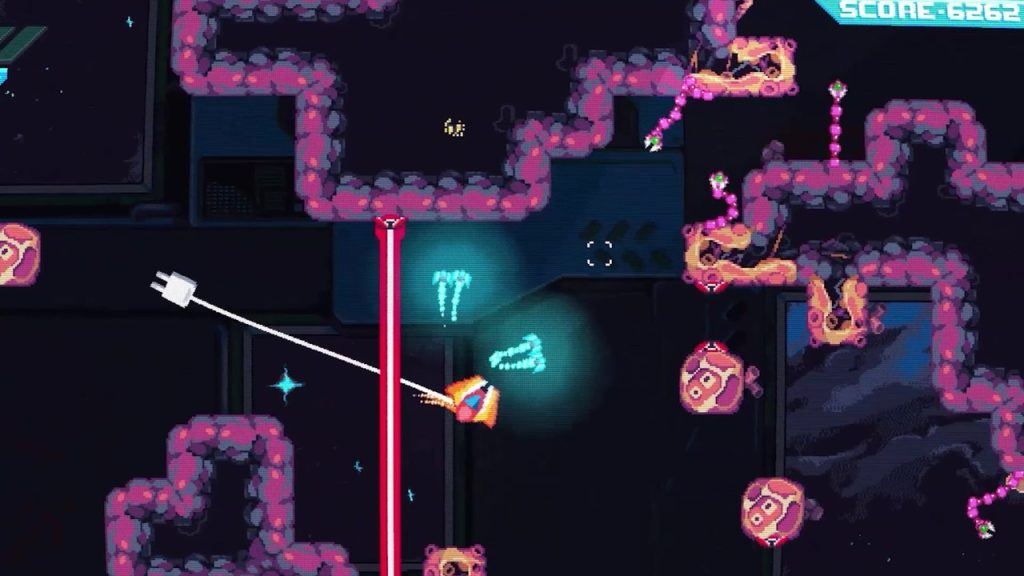
All four charging docks replenish energy, while others refill a variety of gauges. Smaller pods can be found randomly too, giving a quick boost while you seek the next dock and deal with the red-hued enemies that haphazardly bounce around. In a fun twist, your craft isn’t the only one able to make good use of these charging docks. Dotted around are drifting helper craft, most of which are completely kaput upon discovery. You’ll need to drag them to the appropriate port to revive them, at which point they’ll follow you around and deal with enemies — very handy for when things unexpectedly become hectic, or when you’re tethered next to an emerging rift.
Every five stages a boss appears, most of which spew bullet-hell-style projectile formations and searing lasers. The idea is to gather as many helpers as possible and increase your craft’s capabilities shrewdly, with the end of each stage giving a choice of five upgrades. It’s possible to add side guns, spawn next to a random charging dock, increase the health/shield/energy gauges, become faster, and add double damage — both for your weaponry and the amount taken, making this choice a gamble. Scope for ‘wild builds’ is slim, however, as these aren’t the kind of upgrades that’ll make you overpowered, only giving incremental boosts.
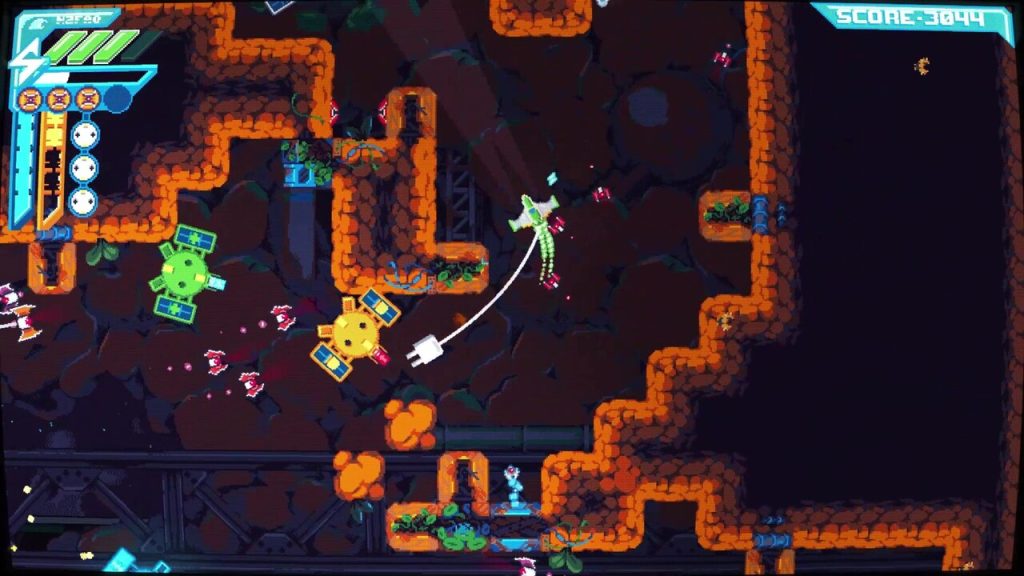
During a boss fight, chances are you’ll lose most of your helpers. This inadvertently gives the experience an unmistakable ‘loop’, in the sense that every five stages, the loop of finding and reviving helpers begins anew — only there are now more enemies on screen, and the maze-like levels are larger than those before. You do get to pick a major upgrade after a boss, though, and these have a more ‘game changer’ feel to them, such as the ability to turn invisible and summon a wave of helpers once per stage. Together with extra craft to unlock — some of which have wildly varying stats — this provides a few different things to experiment with. Not a great deal, but there is potential.
Upon death, you’re shown which enemy type killed you and given a survival tip. In my case, a constant reminder to use slow-mo. A failed run sees you thrown back at the start, with nothing in the way of permanent upgrades. The only other mode present comes in the form of optional challenges, one of which involves not being able to shoot and relying on helper craft only.
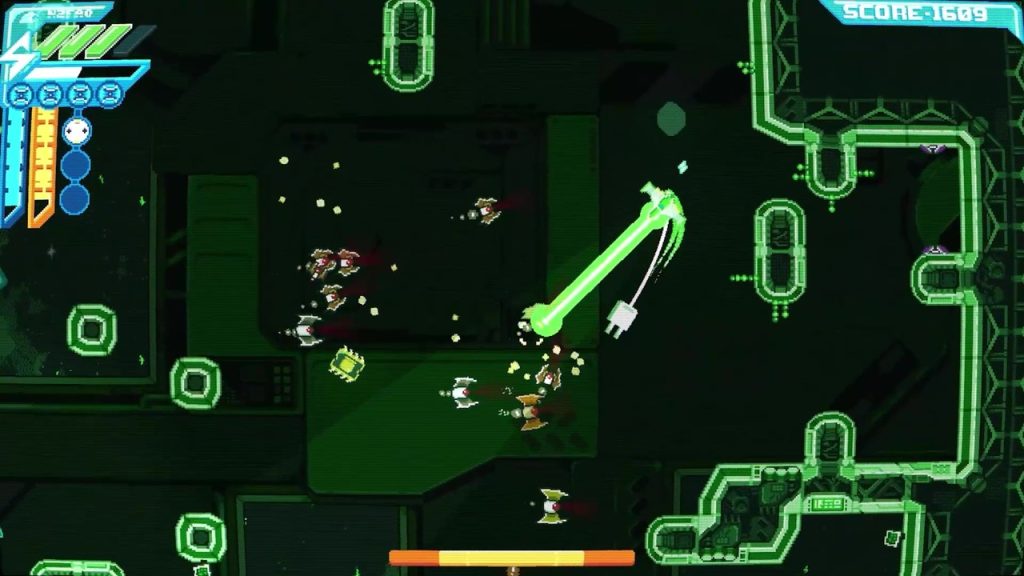
As much as it pains me to say it, HYPERWIRED isn’t much of a looker. If it weren’t for the rotational effects, it would closely resemble a typical NES shooter from the system’s early days. The HUD, too, is a bit cluttered due to being populated by indistinct gauges. I didn’t even realise that scores are tracked initially, as this part of the HUD uses white text on a light blue backdrop. While the music changes every five stages, it doesn’t do much to get you into the mood either, comprising of generic beats. Perhaps I should just be thankful that it isn’t too repetitive.
These presentational woes only drag HYPERWIRED down further. Once you get into the swing of things, learning which upgrades help the most and making use of the limited tools available, it does become more engaging. That’s until your run is ended by a wall-mounted laser beam that you were somehow nudged into, or run out of energy next to a rift and lose all four health points in just as many seconds. Equip a few accessibility features, such as assisted aiming, and you’ll have a more enjoyable time. Chances are, though, that it’ll never have you truly wired.
Sidral Games’ HYPERWIRED is out now on all formats. Published by Entalto Publishing.