

Earlier this year Microids dusted off the Myst-style point ‘n click adventure Amerzone – The Explorer’s Legacy for an impressive UE5 makeover. It proved to be a great starting point for a new series of remasters, potentially preserving what made them cult classics while modernising the experience. Barely six months later, the similarly remastered follow-up is upon us, with Syberia’s world crafted by the same late comic book artist, Benoît Sokal. It even has links to Amerzone – which involved returning a colossal egg to a lost jungle – although you don’t need to have played it first. Would I suggest playing it over this? Well, let’s not jump the gun.
Whereas Amerzone harked to 1998, released on PC and PS1, Syberia made its debut in 2002 and graced such platforms as the PC, PS2 and Xbox before gaining a re-release on the DS and a slew of modern consoles. Being four years apart, it was a more advanced experience overall, shunning the Myst-style screen clicking in favour for a central on-screen character and a traditional point ‘n click interface. The Syberia series grew to become a success, especially in Europe, with the newest entry Syberia: The World Before launching just a few years ago.

Taking place in an alternative universe, we’re introduced to Kate Walker – a mild mannered lawyer from New York. She has travelled to a quaint European town to sign a deal that’ll grant an American toy company ownership of a factory that produces talking clockwork automaton robots. So advanced are these automatons, that they can be found throughout the country, carrying out everyday duties. After unpacking and exploring the town, Kate is informed that the deal is off – the elderly factory owner instead wishes to pass the business onto their last remaining heir. This person’s whereabouts just so happens to be a mystery, provoking a quest to track them down and secure the deal. Cue plenty of phone calls from Kate’s irate boss, some of which become quite comical with Kate finding herself in increasingly unlikely situations.
Ditching the point ‘n click interface – although not entirely, as puzzles are still cursor driven – we’re given direct control over Kate, who true to her name, can only walk slowly when indoors. Environments are now in full 3D and realistically rendered, featuring reflective surfaces, rich textures, and natural lighting. It’s a very eye-catching experience, for the most part, and that’s despite this remaster opting for the Unity engine over UE5. Presumably as a cost cutting measure, the CGI cut-scenes still use clips from the 2002 original, only upscaled. The differences are jarring, especially when Kate is present within a scene, sporting far more chiselled facial features. Dialogue is also unchanged, with a few typos present. Weirdly, there are no manual saves either, instead auto-saving regularly. This appears to be down to the fact that you can’t die in Syberia; it’s a linear experience with no means of failure.
Kate carries a journal that tracks quests and stores documents, which helps keep things relatively straightforward. As this is an authentic remaster, everything is just as it was in 2002, with no new locations or alternative puzzles – it’s merely better-looking and sounding. It has a few PS5 features too, such as phone conversations playing through the controller’s speaker. It may have benefitted from streamlining, as there’s quite a bit of backtracking in the first two locations, including long train station platforms to tirelessly run back and forth along. If you become stuck – which is likely to happen, given there’s no on-screen main objective – it’s then a case of checking every location to see what you’ve missed. Thankfully, icons appear as you approach something interactable, and during conversations mission specific dialogue is marked.

Kate’s journey takes her from the village and into the automaton factory, in which she must create her own travelling companion – the protocol abiding Oscar. Think along the lines of a Victorian era C3PO. Dialogue between the two is often light-hearted, with Oscar misunderstanding Kate’s American slang. Oscar happens to be a train conductor, operating the clockwork powered train that carries the duo from one European-inspired fictional country to the next. Having to rely on the train to progress means that when arriving in a new location the focus is usually on finding a way to recharge it. Amerzone employed a similar process, making it quite clear the two come from the same developer. This does however mean that each chapter begins in a fresh location, while the train acts as a home base of sorts.
The second location proved to be my favourite, featuring a station that doubled as an aviary, located next to a grand university. From there more oppressive and darker themes emerge, with a very distinct soviet influence, before ushering Kate and Oscar into a more picturesque location for the finale. Each location has a handful of NPCs – although generally no more than four or five – along with half a dozen puzzles, some of which involve gathering items spread across several locations. Most puzzles however involve using consoles, ergo flicking switches and pressing buttons in the correct order to operate machinery. True to the era, it still has some more typical point ‘n click puzzles too, such as finding a door code scribbled on a discarded business card and causing a distraction by pouring soap power into a fountain. One early puzzle left me flummoxed for a good hour, suggesting that ebony wood was required, only for the solution to require wood with a light tan. This made for an opening that wasn’t as welcoming as anticipated.
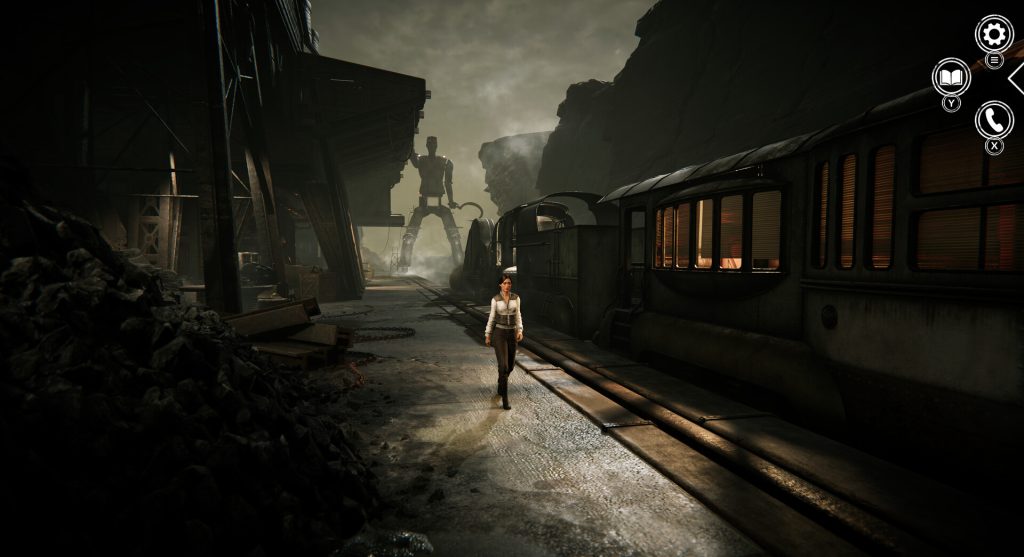
Syberia Remastered is a bit of an oddity. Kate is instantly likeable – she’s an easy-going lawyer, not an action hero – and the environments are always interesting, sporting art deco features and automatons weaved into their design. Although there is a sense of danger within the third location, it soon settles back into comfort and familiarity, making for a storyline that doesn’t always engage due to its lack of dramatic twists. Kate is simply out to find a person with an air of mystique, which she achieves in a methodical fashion, asking the right people the right questions each time. The conclusion did leave me satisfied; I just wished that the second location didn’t end up becoming its most memorable.
As a remaster, it’s a mixed bag. The graphics are appealing, the voice acting is serviceable, and the UI is easy to navigate. The PS5 features help it to feel reasonably polished too, with vibrations mimicking Kate’s footsteps in some locations. By keeping this authentic however, it doesn’t always feel like a modern experience. There are lots of locations that simply see Kate running down long featureless corridors which could have been shortened or populated with new NPCs to help the eerily quiet locations feel more alive. Kate would have benefitted from a greater range of animations too, even struggling to jump at one point.
Indeed, with the foundations already laid out, budget constraints seem to be the biggest hurdle the developers had to overcome here, feeling like a step backwards from this year’s Amerzone revival in terms of polish. Only a small step, mind. It’s still a decent way to experience Syberia. It’s just a shame that instead of sparkling all the way through, it only occasionally shines.
Microids’ Syberia Remastered is out now on PS5, Xbox Series and PC. Developed by Microids Studio Paris and Virtuallyz Gaming.