

Over the past few years, QUByte has been picking retro games from Piko’s extensive catalogue and pairing them together for inexpensive digital collections. Results have been somewhat mixed, as while the games chosen are reasonably well known within retro gaming circles, many are far from being considered classics. This new collection sees six previously re-released beat’em ups repackaged at a more sensible £15-£16 price point, along with a newcomer. Bolstered by more options, it makes for a far more appealing package.
It’s presented in a similar way to QUByte’s recent Accolade Sports Collection and the often forgotten Visco Collection, featuring save states, a rewind tool, new digital manuals that also include hints, and most importantly a cheat menu for each title. While a handful of games are straightforward enough to blitz through, the ability to toggle infinite health makes the harder games present far more palatable, while also ensuring that anybody picking up this collection will be able to easily complete all seven games. It’s also possible to alter screen sizes, which we believe wasn’t possible in some of QUByte’s earlier standalone releases.
Weirdly, the first two games present aren’t strictly beat’em ups. Sure, 1993’s First Samurai and 1994’s Second Samurai entail slashing demons with a sword, but they’re far removed from the likes of Golden Axe, playing more like action platformers. First Samurai is the SNES version and is non-linear, in the sense that five runes must be found within each sprawling level before discovering the exit. Along the way, magic bells must be collected and used in certain locations to progress, removing walls and such. It’s a short game that’s also ugly by SNES standards, but still worth playing through due to its clever level design and comical tone. It doesn’t take itself seriously at all and is all the better for it.
The Mega Drive sequel meanwhile is a very different game, partly due to Psygnosis advising on its direction. It’s more arcade-like than its predecessor, while also being far sillier – including a dinosaur riding scene and the chance to use jetpack while firing lasers. While it does start to outstay its welcome a couple of hours in, it showcases a lot of imagination, and the tidily drawn visuals still look the part. Not a surprise considering this was quite a late Mega Drive release – Psygnosis apparently scrapped the Mega CD version to focus on PS1 development.
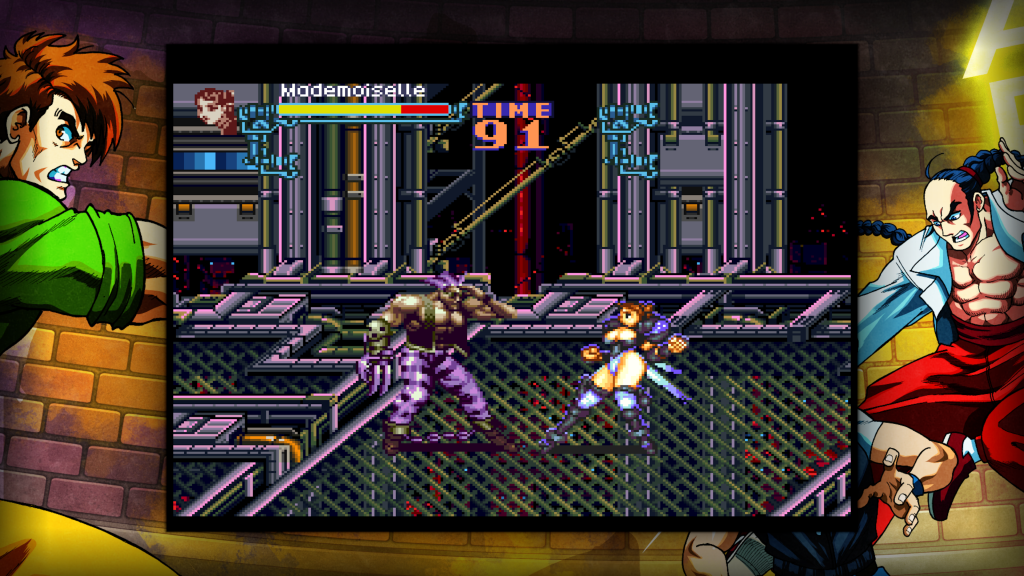
Not even the sight of a samurai riding a dinosaur can top the weirdness present in Gourmet Warriors. This is a more traditional scrolling brawler, originally only released on the Super Famicom in Japan. It comes from the team behind the Choaniki series, and certainly shares a few similarities, such as a dedicated ‘pose’ button that makes the muscular stars strut their stuff. It gets its name from the fact that between stages any collected foodstuffs can be made into a meal, providing a health boost that varies on ingredients used. Unless choosing to experience it with all three characters (Bonjour, Mademoiselle, and Très Bien) you’re looking at around 30-40 mins playtime. It’s a competent brawler that’s delightfully warped.
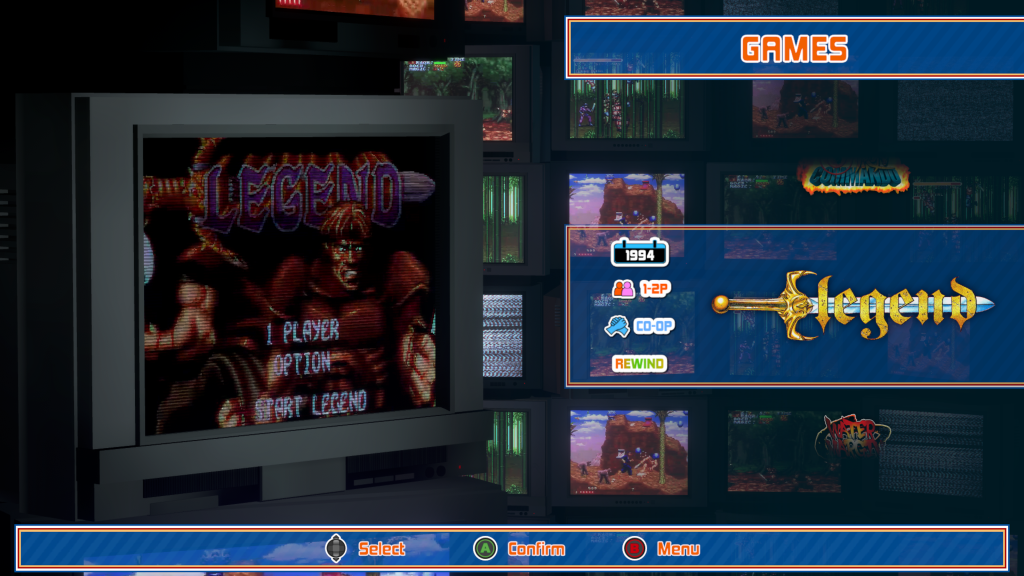
Iron Commando and Legend come from European developer Arcade Zone, formed from ex-Titus employees. Both are SNES games, with Iron Commando having a grimy modern day setting and shooter elements (the two heroes can pick up shotguns and other arsenal) while Legend is a fantasy hack’n slash similar to Golden Axe. Iron Commando, from 1995, is the more diverse of the two due to having motorbike and minecart stages. Legend drags on (no, that isn’t a pun) but boasts superior collision detection, making It feel more refined. The pixel art in both is decent, and while they’re clearly trying to mimic Capcom’s output at the time, they’re passable enough alternatives. It’s also worth noting that they’re deep cuts from the SNES library, not exactly being the first games to spring to mind when thinking about Nintendo’s 16-bit system.
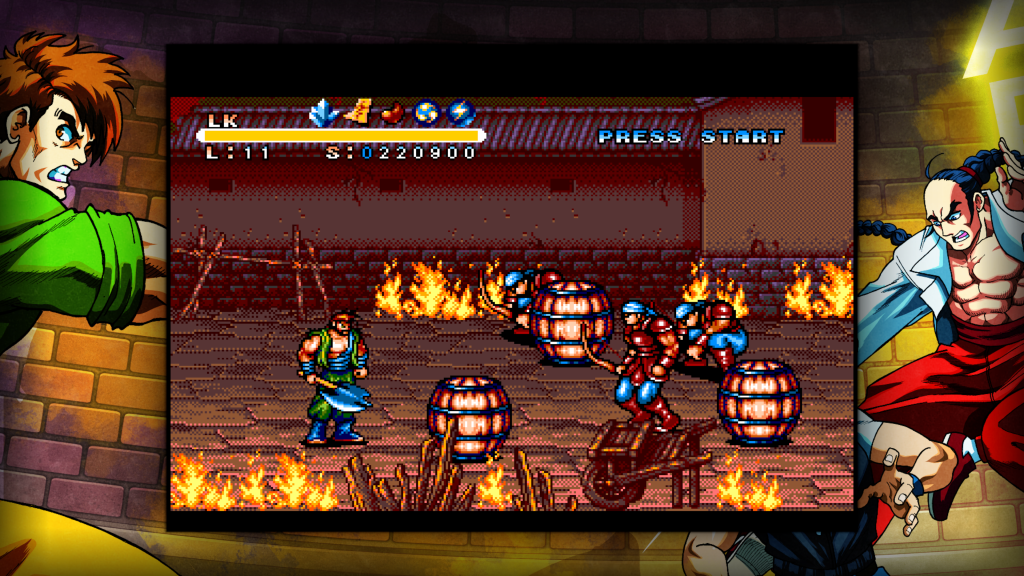
Then there’s Water Margin: The Tale of Clouds and Winds, which began life as an unlicensed (unofficial) Mega Drive game before gaining an English translation and both a digital and physical re-release some two decades later. As a 1996 Mega Drive game, it isn’t unreasonable to expect the visuals to be far better. It is however worth keeping in mind that it was likely made without official development kits or guides. Essentially, it’s a feudal take on Golden Axe, using a 14th century Chinese novel as its inspiration. There are three heroes to choose from, each with varying stats, and magic attacks can be chosen from a menu via few button presses. While it’s no Golden Axe 2, it’s far more enjoyable than the disaster that was Golden Axe 3. The cheats menu also allows the magic animations to be shortened, helping to keep the pace swift. If you’re curious, the standalone release will only set you back £3.99. Here, in this collection, it’s one of the better games.
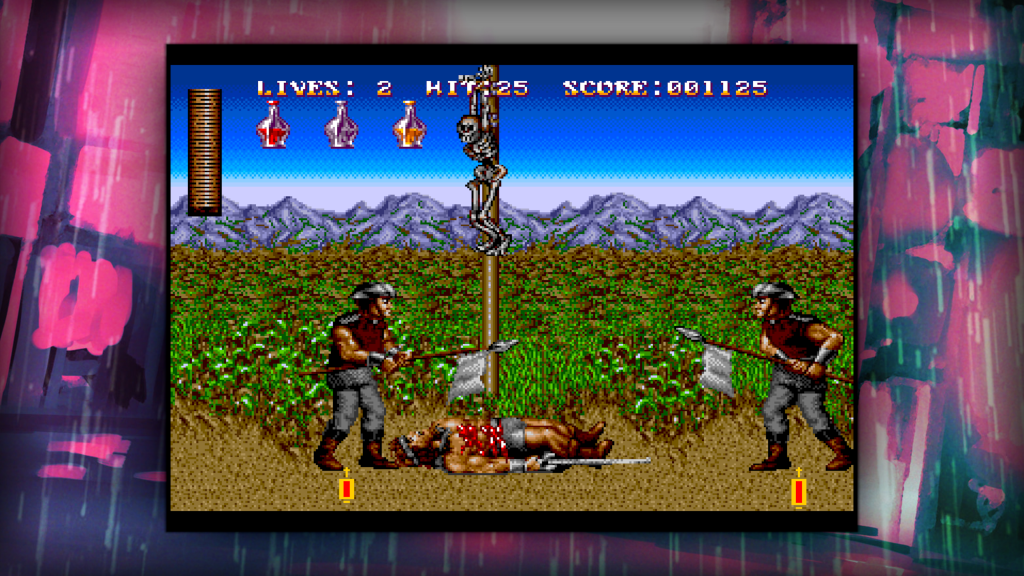
This leaves us with the Mega Drive version of Sword of Sodan, which we don’t believe has gained a standalone release through QUByte before (although it can be found on a Piko Evercade collection). It falls into the same camp as SEGA’s much loved yet much maligned Altered Beast, in the sense that it looks quite impressive in screenshots but in motion is a different story. In 1990 this side-scrolling fantasy hack ‘n slash turned heads due to its large sprites and buckets of gore (bosses can be decapitated) but stilted animation, clunky controls, and difficulty spikes made it very frustrating to play. The potion mixing mechanic was quite forward for the time though, and it does have a choice of either a male or female protagonist. Using cheats, I was able to finish it for the first time – something I couldn’t even achieve on Evercade. Turns out it’s pretty short, while also becoming teeth grindingly bad during its final moments. It’s understandable why QUByte hasn’t touched this one before.
If you’re thinking that this collection sounds like an eccentric mix, you’re right. It’s an odd combo of European games trying to mimic Japanese greats, and games once considered too weird for a more concerning western world. Nothing here is on the same level as genre mainstays such as Golden Axe, Final Fight and Streets of Rage. At the same time though, every game present is worth playing through at least once. Second Samurai turned out to be far better than anticipated, raising a grin thanks to its silliness, and I enjoyed playing Iron Commando and Gourmet Warriors with a friend. First Samurai isn’t bad either, helping to break up monotony of Legend and Water Margin with its ‘find and collect’ gameplay. Sword of Sodan can sod off.
It’s a shame we didn’t get this package to begin with, as when combined the contents make for a varied and interesting experience, and it represents far better value overall. Even with cheats enabled, you’re looking at a good 6-7 hours to see the credit roll on all seven titles. These are deep cuts of beat’em up history rather than fine cuts, and for a modest £16 that’s…fine.
Beat ‘Em Up Collection (QUByte Classics) is out now on PS5, PS4, Xbox Series, Xbox One, Switch and PC.