

The SEGA Saturn had one of the more peculiar game catalogues. More diverse than the N64’s library and with far less slop that the PS1, it largely consists of scrappy but reasonably faithful arcade conversions, a small selection of system showcases from SEGA themselves, a seemingly random bunch of third-party titles, and a wealth of desirable Japanese imports that probably would have sold well in Europe and America had they been given the chance.
Amongst all of this lies a handful of European exclusive titles. Ten in total, which again are a peculiar bunch, with only three being sports sims. The majority launched in 1997 which was when the system was arguably in its prime, only for it to be discontinued in Europe halfway through 1998.
The fledgling 32-bit console made its debut in Europe in July 1995, and indeed, it’s odd that we didn’t start to see regional exclusives for another two years (aside one exception) quite possibly due to publishers seeing how the war between the PS1 and Saturn panned out. SEGA themselves even published a handful of European exclusives, and in a few instances, it seems that this was the only way to save them from cancellation.

The first regional exclusive wasn’t a huge stretch of the imagination. The Gremlin developed UEFA Euro 96 England launched in 1996, published by SEGA and created using the Actua Soccer engine. It’s accredited to helping boost Saturn sales in the UK. On a related note, Actua Soccer: Club Edition was a UK exclusive for the Saturn but usually isn’t considered as such due to it being a mere update that added premiership clubs. Unsurprisingly, these two are the cheapest regional exclusives to acquire today, usually costing no more than a fiver.
SEGA also published World League Soccer 98. Arriving in May of 1998, it was one of the last European releases, and reportedly had a long development – which resulted in it becoming the Saturn’s best football game. Like so many late Saturn games, it’s a shame it didn’t appear sooner in the system’s life, especially when EA didn’t put much effort into FIFA on Saturn, with yearly entries outsourced to smaller studios. World League Soccer 98’s developer Silicon Dreams would later play a crucial role in bringing football to the FIFA-absent Dreamcast, so it’s fair to say this partnership paid off.
Sticking with sports, Jonah Lomu Rugby was the only game Codemasters brought to the Saturn – and that’s despite the UK publishing powerhouse having a large presence on the Mega Drive. They originally had a couple of games in the pipeline, including Micro Machines V3, but it seems that development stalled and in the end only 1997’s Jonah Lomu Rugby was finished. Rage were behind this conversion, which was positively received, gaining 91% from SEGA Saturn Magazine and 79% from Saturn Power.
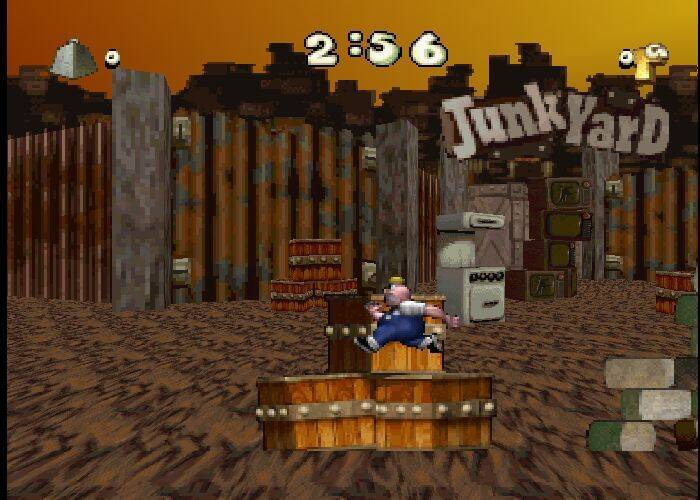

Rage were also responsible for 1997’s Trash It. The gaming press had a field day with this one, unanimously declaring it to be trash and only fit for the bin. The puns wrote themselves. Featuring rendered 2D visuals, Trash It quite literally involved smashing predominantly brown blocks with a hammer before sweeping them up, offering time-limit focused arcade-style gameplay. Review scores were incredibly low, with SEGA Saturn Magazine even failing to receive a review copy from publisher GT Interactive. As it wasn’t a huge seller, copies can be hard to find nowadays. US gamers certainly didn’t miss out on a hidden gem here.
How’s about a trio of adventure games to shake things up? Just like World League Soccer 98, Cyro’s Atlantis: The Lost Tales was one of the last games released in Europe, arriving in June 1998. It’s listed online as releasing in 1997, but this appears to be incorrect as it was reviewed in the June 1998 issue of SEGA Saturn Magazine. SEGA stepped in to publish this one themselves, allegedly impressed with the additional work Cyro put into the Saturn version such as mouse support and a whole new engine. The game itself had much in common with Myst, featuring pre-rendered backgrounds, only here they can be explored completely with each location having 360 degree movement. Reviews were mostly middling due to the game’s slow pace, long loading times, and obtuse puzzle solutions. On PC though it performed well commercially, leading to another two entries – neither of which materialised on Dreamcast.

SEGA also picked up the publishing rights to 1997’s vibrant point ‘n clicker Discworld II: Missing Presumed. It’s easy to see why as Terry Pratchett had a large following in Europe. The first Discworld, released in 1995 by Psygnosis, was also a modest seller. The story saw wizard Rincewind out to find Death and convince them from coming out of early retirement – a comical set-up, with the game’s humour being one of its selling points. It was also visually slicker than the original, being far more cartoon like. Review scores were mostly in the 8/10 ballpark.
Lastly for adventure games there’s Frankenstein: Through the Eyes of the Monster, released by Interplay in 1997, just in time for Halloween. This too is a point ‘n clicker, only of the FMV variety. Tim Curry played the role of Dr. Frankenstein, and his performance was one of the better aspects. Reviewers generally found it a bit clunky and unfairly difficult. “Confusion and boredom do not a great adventure make,” said Saturn Power before dishing out a middling 49%. SEGA Saturn Magazine enjoyed it a bit more, opting for a 74% score and finding the sound, graphics, and plot all decent enough. Neither magazine appeared to realise that Frankenstein had been stuck in development for years, originally in development for the SEGA CD before switching studios entirely.


1997 also saw the release of Manic Media Productions’ Formula Karts Special Edition, again published by SEGA. The PS1 version was released by Telstar who had a presence on Saturn during its early days with games such as Starfighter 3000, but it seems that by 1997 they had chosen to side with Sony. This go-kart racer had scrappy visuals, which appear to have been sacrificed in quality in favour of speed – it was a nippy racer that got the feel of go-karting right, and it featured split-screen play too. Reviews were generally favourable and if any US Saturn fans are looking to expand their collection it’s one to consider.
Swagman from Core Design and Eidos is another European exclusive released in 1997. And yes, that’s the same Core Design who gave the world Tomb Raider. This nightmarish top-down adventure, featuring 2D pre-rendered visuals, had been knocking around for a while, once even planned for the 32X and Atari Jaguar CD. All signs point to Core and Eidos simply wanting to get it out of the door – it launched around the same time as the far flashier Tomb Raider II and Fighting Force, and ended up being the last Core developed game on Saturn following a string of high profile cancellations. Review scores were mixed. The two remaining UK Saturn magazines both found something to enjoy here, whereas EDGE could only muster a 5/10. Swagman isn’t too well remembered nowadays and that’s probably for the best.
Appropriately enough, we’ve left Z for last. Perhaps we should have started with Atlantis. Like a few other games mentioned, Bitmap Brothers’ rampaging robot real time strategy game was stuck in development for yonks. The well-respected developer was known for their line of Amiga greats (an Amiga version of Z was even almost finished) but struggled to adapt to the new generation of consoles and PCs. Despite being behind the times visually, it was able to ride the coattails of Command & Conquer’s success when it finally launched on PC in 1997. The console versions arrived in 1998 and weren’t huge sellers, with the Saturn’s small print run making it one of the rarer games on the platform. It arrived so late in the system’s life that Future’s Saturn Power magazine had closed, leaving just the official publication on newsstands. They gave it an 85% while calling the graphics “crap.” Talk about being blunt.
While it’s a shame that we didn’t see more exclusives in Europe, it’s also pleasing to see that SEGA Europe was able to help four different UK developers bring their games to market, helping to plug a few gaps in the sporadic release schedule in the process.