

Here’s a first-person horror that’s dark in both senses of the word. True to its name, the plot involves a deranged doctor performing sadistic experiments on unwilling victims. After waking up following an abduction, one of the first sights is of a fellow captive being sliced in two while still alive, making for a grim yet memorable opening. Or at least, this would be the case if the screen weren’t so dark. Even after finding a headtorch, it can be hard to locate the path ahead, so make sure you have your TV remote handy to adjust the brightness.
Once you can see what you’re doing, what ensues is a struggle to escape a bunch of confusingly entwined locations, going from a school with an indoor sports hall to a movie theatre, before eventually reaching a multifloored dilapidated hospital. Progress is often halted by the need to locate a key, routinely gained as a reward for solving a puzzle, or the need to locate door keypad codes by scouring the environments. The game’s definition of a ‘puzzle’ varies from merely having to gather a bunch of specimen jars to pressing keys on a piano to mimic a musical toy. While mostly simple, they’re more impactful than the action sequences, which suffer due to the awkwardness of first-person jumping.

Combat features too and is equally woolly and cackhanded. The two weapons (a pistol and a shotgun) feel flimsy and lack feedback, while the masked adversaries – of which less than a dozen appear during the three hour playtime – don’t recoil when shot. A trio of boss battles see minor difficulty spikes, in the sense that you may have to retry each 2-3 times. During a battle against a sinister yet cartoonish dinner lady, they somehow became snagged on a table and consequently couldn’t pursue or attack. So dim-witted is the AI that I feel confident in saying that Gore Doctor could be easily beaten without taking more than a couple of hits.
An elevator sequence is used for padding midway, with this descent into deeper pits of despair lasting around five minutes. The first half merely sees fowl beasts attempt to claw their way in and is void of interactivity, while the second half involves dodging saw blades. Fail here and you’re thrown back to the start of the ride, forced to endure the first half again. Luckily it isn’t too hard to memorise the saw blade patterns. Still, repeating this section twice was enough to leave a sour taste.
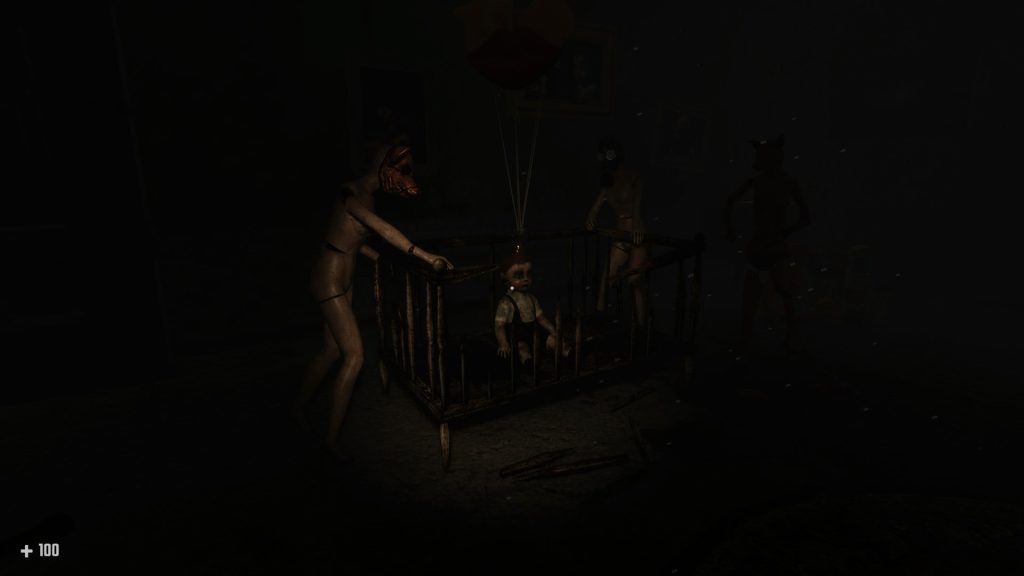
Visually it’s marred by odd lighting artefacts, with most of the already waxy textures featuring reflections – even non-reflective objects such as books. It’s appropriately bleak though, with pools of blood and human remains common sights, and most objects showcase minor details. While not a man of many words, merely uttering the occasional obscenity or congratulating themselves after solving a puzzle, the voice acting isn’t too bad and there are plenty of doctors’ reports and diary entries to stop and read.
In the end, I didn’t get much out of Gore Doctor outside of the satisfaction from beating its handful of puzzles. It doesn’t take itself too seriously (one boss is a circus clown), but that doesn’t make it any better, and most of its ideas feel thrown together, including the paper-thin storyline. Instead of being left to try to figure out how to escape a location, you’re instead forced to look high and low for keys – an idea lazily reused from start to finish. There isn’t much scope for repeat playthroughs either, as there’s nothing in the way of different endings, although the achievement list suggests it has at least one optional puzzle. That was the only achievement I was missing after just under three hours of play.
Gore Doctor may live up to its promise of being gory, but its appeal doesn’t extend far beyond that – and the gore alone certainly isn’t able to justify the £16 price tag. Leave this one to linger in the dark.
Salient Games’ Gore Doctor is out now on PS5 and Xbox Series. Published by Ultimate Games. A PC version is also available.