

This modern retro first-person shooter has an incredibly apt name, letting players know what they’re in for before even pressing the start button. We’re introduced to Johnny Turbo (no, not the TurboDuo console’s ill-fated mascot), a Terminator-esque cyborg with upgradeable circuitry who just happens to have a chainsaw concealed in their leg. By sliding along the ground, Johnny can slice up his cyberpunk adversaries effortlessly. That’s the overkill part. As for the ‘turbo’ aspect, Johnny is quick off the mark and can cover large distances swiftly, dashing and wall running around the neon-drenched city of Paradise at a breakneck pace.
Chainsaw leg kills are Turbo Overkill’s way of luring players in, sold on the promise of a new way to maim. A couple of hours in said ability starts to become overshadowed, save for when Johnny gets creative with his kills within cut-scenes. A Trojan Horse gimmick, if you will. It’s the guns that instead steal the show, each as meaty as the last, and all are upgradeable with secondary fire modes – which in some instances greatly change a weapon’s cosmetics, making them sleekier, beefier, and even more high-tech.
The crime ridden city of Paradise – under siege from a rogue AI known as Syn – is peppered with Borderlands-esque vending machines (“Guns, guns, guns!”) that can be used to purchase new arsenal, upgrade chips, ammo, and more. The ‘Splice’ machine meanwhile allows Johnny’s abilities to be augmented, making enemies drop more cash or ammo, adding cluster grenades to ordinance, and generally making Johnny more adept. Only two augments per limb can be equipped at once, giving scope for experimentation to find the ideal loadout.
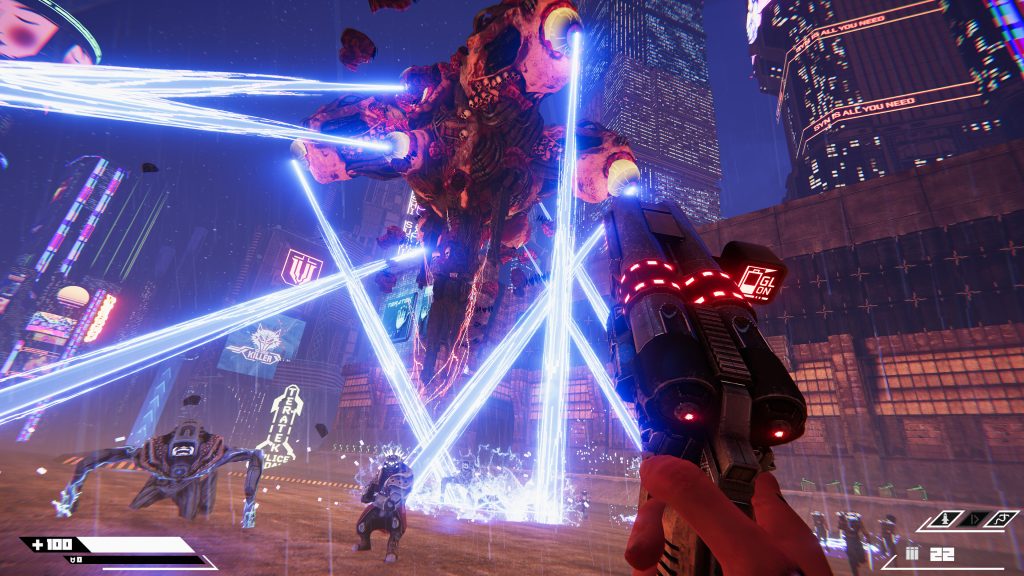
The stages, and level of carnage, are all based around Johnny’s very particular set of skills. A lot of time is spent performing acrobatic platforming, running along marked walls, leaping off bounce pads, sliding under gaps, and more. Things are deceptive at first, in the way that far off platforms may seem out of bounds but can be reached with a well-timed double jump and a dash. Soon enough, you’ll master getting around. Secondly, enemies come thick and fast, most of which can withstand several double-barrelled shotgun blasts. Gaggles of weak enemies occasionally swarm out of doorways, ready to be chainsawed into chunks, while larger robotic foes require missiles and other heavy firepower. In that regard, and a few others, it’s very similar to DOOM Eternal.
This means you’ll be switching weapons often, with even the starting pistol remaining useful due to the ability to lock onto five enemies at once. There are similarities within Johnny’s arsenal though. Double assault rifles aren’t far removed from the mini-gun in terms of speed, and the plasma rifle is almost as punchy as the single-barrel shotgun. Ammo is found easily, although one or two types may run dry occasionally. Mini-missiles are on a cooldown, while later a slow-mo ability is introduced – vital for hitting fast moving targets. Power-ups are present too, featuring sparingly. The ‘God Mode’ power-up doesn’t appear until several hours in, for instance, coming off as a cheeky homage to DOOM rather than a staple.
Stages are lengthy, taking around 20-25 minutes to beat, and each chapter ends with a boss fight – including a trio of speedy bounty hunters to eliminate. Locations are based on familiar locales from in and around Paradise – an aquarium, nightclub, sewer system, tower blocks, a scrapyard, etc – but do come off as abstract in places, ushering you from one boxy room and grey brick maze to the next in search of coloured key cards, with not much in the way of instantly recognisable backdrops. It’s never a drab experience despite this, as it usually isn’t long until you’re treated to a sea of neon billboards or a jaunt around a tower block complex that shadows the entire city.
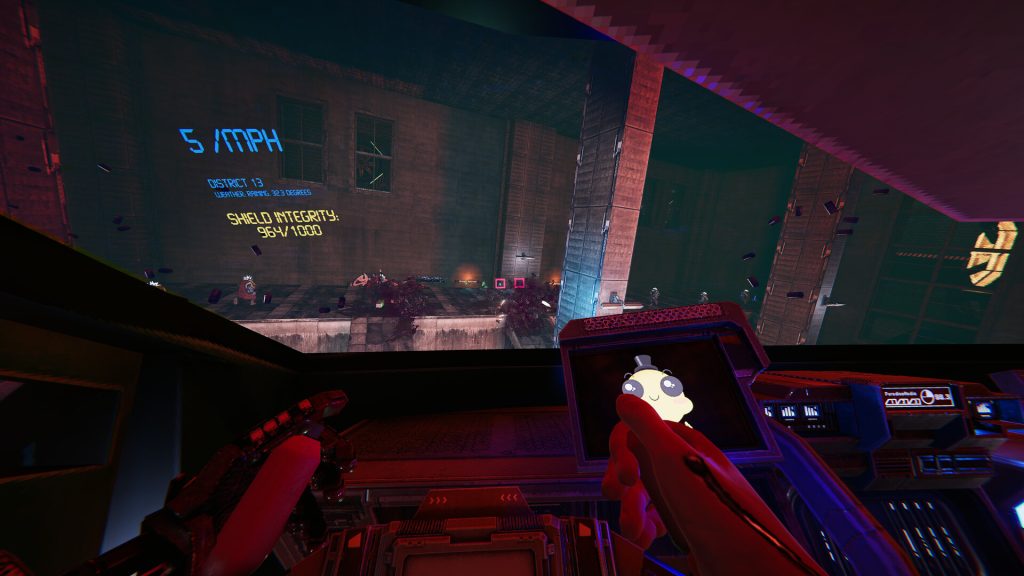
Helping to mix things up further are vehicular sections. The first of these is a hover car, adding a slight Descent-slant as you head into tubular sewer pipes while firing missiles and spinning up the chain gun. Later, there’s a motorbike section that sees Johnny outrunning a searing laser emitted from a giant robotic eyeball, leaping off ramps, charging lasers, and destroying blockades. Together with new abilities, it makes for a fun and playful experience – one with lots of explosions and claret.
The presentation falls a touch short of ‘AAA’ standards, which is understandable considering the £16.99 price point. The graphics are a tad fuzzy in places, and the funky menu font can be hard to read. But there’s no denying that this isn’t a comprehensively modern retro experience, with visuals evocative of the ‘90s while surpassing them in certain areas, a techno soundtrack that complements the action and setting well, and a hefty chunk of variety. It’s something that opens more as you play it, being a little one-note initially but gradually becoming richer with every mechanic introduced. If there’s one thing it’s guilty of, it’s overstaying its welcome – expect to put in around 15 hours on one of the easier difficulties, occasionally becoming lost due to poor waypoint placing. Still, it presents a good mixture of new and old; relentless shooting, pixelated gore, over the top weaponry, ‘90s cyberpunk shlock, and plenty of time to acquaint yourself with one Johnny Turbo. Just be sure not to pick up any of their bad habits.
Trigger Happy Interactive’s Turbo Overkill is out on consoles. Published by Apogee Entertainment. A PC version is also available.