
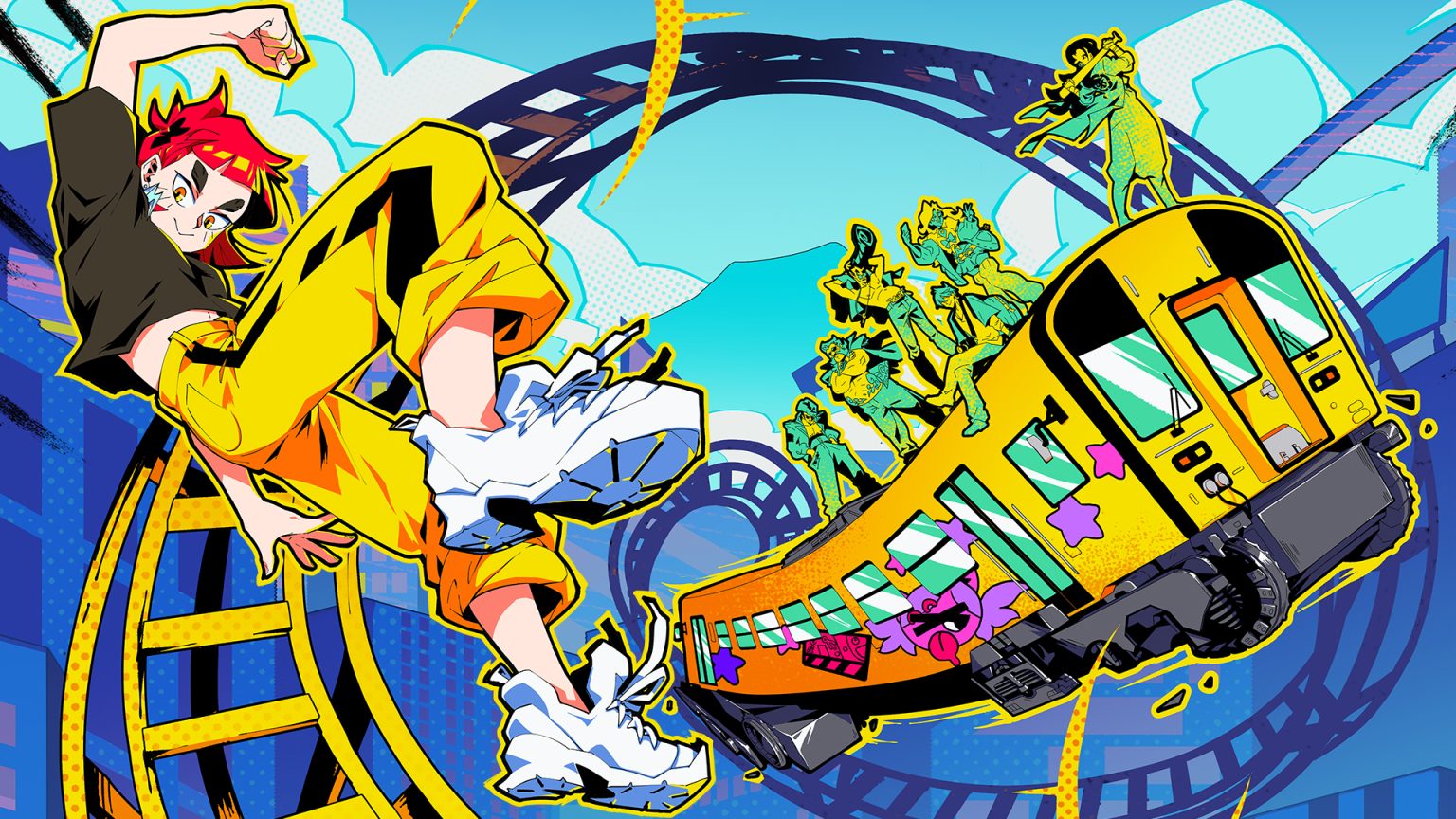
Can you recall playing SEGA’s seminal Jet Set Radio for the first time? Don’t worry if you can’t, as Denshattack is here to recreate that glorious experience, more than able to jog your memory. It sports a similar vibrant cel-shaded aesthetic, has identical themes of teen rebellion, and likewise embraces graffiti culture. It’s time to turn off that radio of yours and mind the gap.
Denshattack’s premise is remarkably different, despite the similarities. The concept of grinding railway tracks and performing stunts while controlling a graffiti-covered train is as outlandish as they come. But as soon as you master the basics, this absurdity vanishes – you won’t even question why said trains can defy gravity, spinning and twisting in mid-air.
Set in Japan, Denshattack sees gangs of outcasts unite and rebel against the ultra-rich, who are living a life of luxury in air-purified domed cities. To crush the capitalists and gain more followers for her cause, protagonist Emi uses the country’s disused railroads to her advantage. This journey takes the gradually expanding cast across the whole of Japan, riling up peacekeepers along the way.
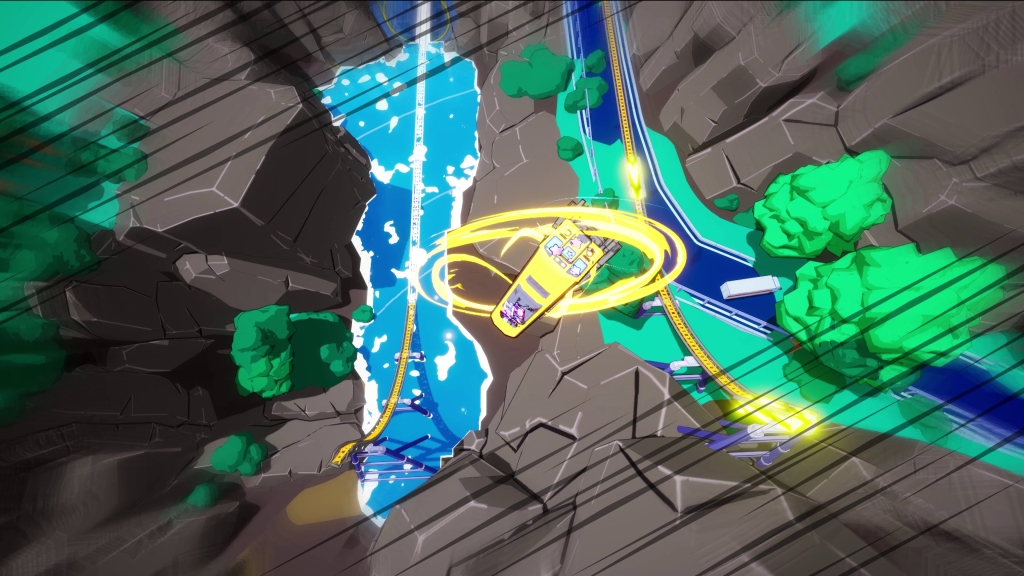
This is no whistle-stop tour, with around 50 stages in total – all of which span vast distances, spread across forests, cities, snowy mountains and more – with surprises frequent. As there are no reused locations, this is the equivalent of a racer with 50 unique tracks. The tutorial does a very good job of outlining the basics, instructing you on how to drift around corners, flip onto adjacent tracks, leap over hazards, grind rails, and perform tricks. These all adhere to skateboarding rules, with gauges to juggle. Unlike a skateboarding game, however, there’s no need to ‘land’ tricks perfectly. It isn’t as if Emi’s train has knees to scrape, after all. This makes for a fun time, twirling through the air before slamming back down onto the tracks.
Periodically, a new mechanic is introduced, always feeling well timed so as not to overwhelm. These include going off-track to navigate circular tunnels, using overhead monorail lines, and conjuring rainbow-like floating track pieces to gain an advantage. All of these additional layers combine into something moreish and curiously demanding, with hazards so frequent that you can’t take your eyes off the screen for more than a couple of seconds. No new mechanic is left by the wayside either, often present and usually chained to other new mechanics.
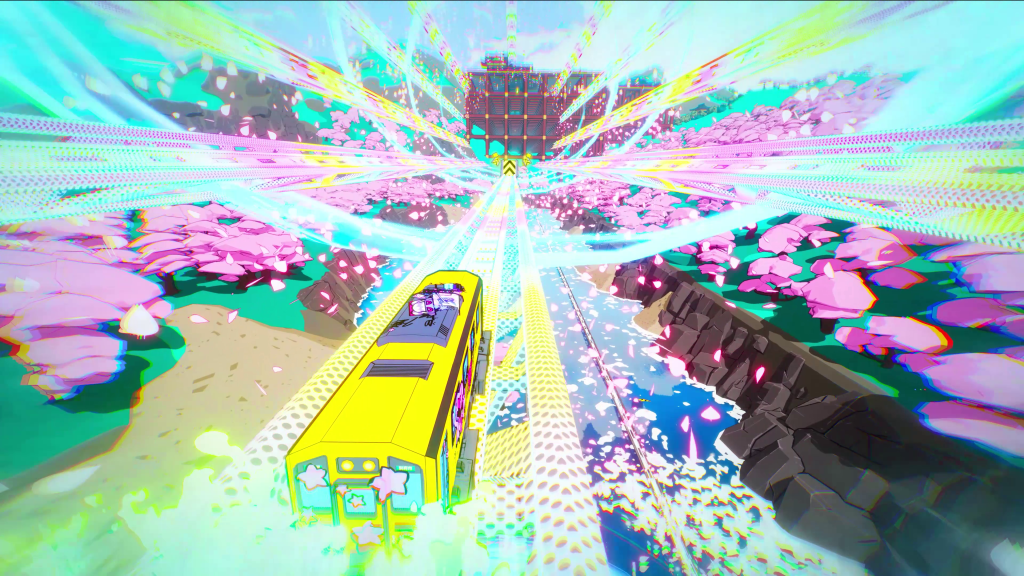
A punishing experience this isn’t, thankfully. Denshattack knows you’re here for a good time, and so the difficulty level has been kept surprisingly low, reserving its gold medals for those seeking a challenge. Things are kept fair by clear signposting, with hazard warnings appearing around five seconds in advance, and red markers indicating when a track is about to end – giving you time to flip or jump to safety. Setbacks are never costly, at least outside of races, putting you back on track just before your last derailing, and always with time to react.
It mixes things up often too, and together with the occasional surprise, this works wonders in preventing tedium from settling in. Three-minute Tony Hawk’s Pro Skater-inspired score-chasing stages, set on looping tracks, are one of the standard stage types. Then there are three-lap races against as many as 30 drone racers, in which it’s essential to place in the top three – a task requiring you to learn track layouts to prevent crashing frequently. I had to retry a few of these several times. Objective-based stages are more compelling, sometimes taking close to ten minutes to beat. They’re set within vast cities with backdrops spreading far into the distance, and involve following a marked route to reach destinations in order to deliver goods, destroy ordnance, or deploy explosives. If you miss a branching path, it’s then a case of looping around until the opportunity re-arises. The signs are there; you just need to follow them.
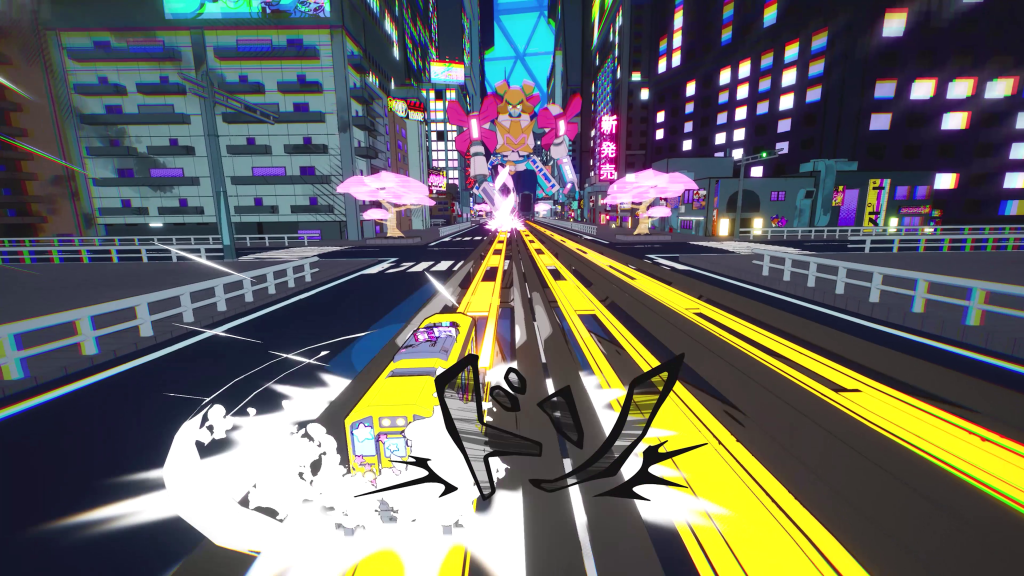
Boss battles feature at the end of each chapter, all of which are unique and full of set-pieces, switching up camera perspectives and adding mechanics such as parrying projectiles and riding rockets. It’s not a surprise to see Denshattack skipping the original Switch, as things can become quite hectic, with the developers truly letting their imaginations run wild. These are yet another mission type that can take around ten minutes to beat, and they’re fun enough to revisit several times over while chasing higher scores.
Every stage has a handful of collectables to find in the form of magazine pages, along with tokens that unlock new graffiti patterns, and eventually new trains. Each of these has one perk and one downside, such as increasing boost speed but reducing the score multiplier timer. If you’re struggling with a race, it’s wise to try a train with a speed-related boon. The graffiti patterns, meanwhile, are creative, and there’s a bunch to unlock, including regional exclusives. Adding further replay value beyond trying to achieve perfect ‘no crash’ runs, stages have a dare list to complete. Some dares can be completed with minimal effort, performing stunts while wall-riding and such, while others require you to take risks, such as ‘near miss’ manoeuvres.
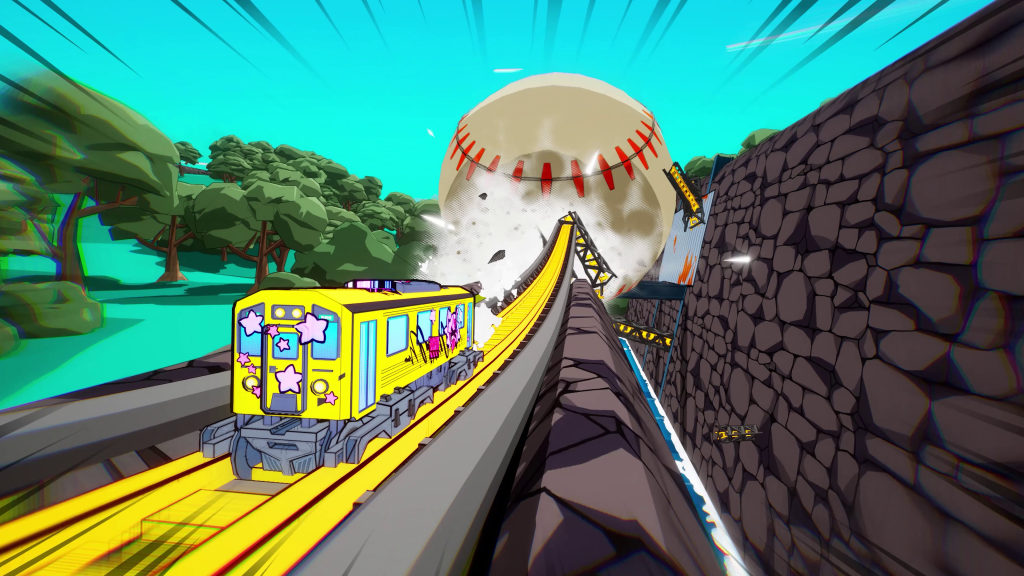
Perhaps the most impressive thing about Denshattack is how quietly confident it is, seamlessly introducing new ideas that never feel out of place. You’ll think you’ve seen everything, only for something like a snowboarding-esque stage to appear, or a boss battle that exceeds all expectations by taking place in a colossal city created for that battle alone. It later dabbles with other genres too, throwing a bit of bullet hell into the mix. Never does it forget that you’re here to savour its unique brand of absurdity; after luring you in with the offbeat promise of being a skateboarding game with rail-riding trains, it delivers with aplomb.
True to its theme of Japanese train lines, Denshattack runs like clockwork. A well-maintained service that won’t let you down. It genuinely feels as if the developers spent months perfecting the basics, from the controls to extra mechanics, before adding as much content and as many novel ideas as they could – all without causing even a hairline fracture to those sturdy foundations. It’s a surprisingly lengthy (8+ hours) experience with style and spectacle to spare, and had this launched on the Dreamcast circa 2002, I’m sure people would still be talking about it today. Play it, and you’ll believe a train can fly.
Undercoder’s Denshattack! is out 15th July on PS5, Xbox Series, Switch 2 and PC. Published by Fireshine Games.