

When the almighty PS1 launched, Takara’s Battle Arena Toshinden gained a lot of press attention, even taking the front cover of various gaming mags. With its vibrant visuals, anime-style characters, over-the-top special moves, and upbeat music, this early polygon-based beat ’em up managed to dazzle. Then, just a few months later, Namco’s Tekken made the jump from arcades to the PS1, showing the world exactly how a competitive fighting game should feel. From that day on, Tekken became synonymous with the PlayStation brand, while Battle Arena Toshinden’s sequels were never able to recapture the buzz surrounding the first entry.
All major franchises began somewhere, with some having humbler beginnings than others. For Tekken, that was in arcades during 1994 – powered by the Namco System 11 board – with just eight playable characters, flat battle arenas with static backdrops, and some unintentionally amusing character-select animations. It went head-to-head with SEGA’s Virtua Fighter before gaining a PS1 conversion in 1995, which went on to become the first PS1 game to break one million sales, helped by glowing reviews. There’s no skirting around the fact, though, that the arcade original represents the franchise at its crudest, with every iteration from then on greatly expanding both the character roster and the depth of the fighting mechanics. While that may be true, there’s still fighting game mastery on display here, and you only need to play it for a few minutes to recall why it was a big deal back in 1994.
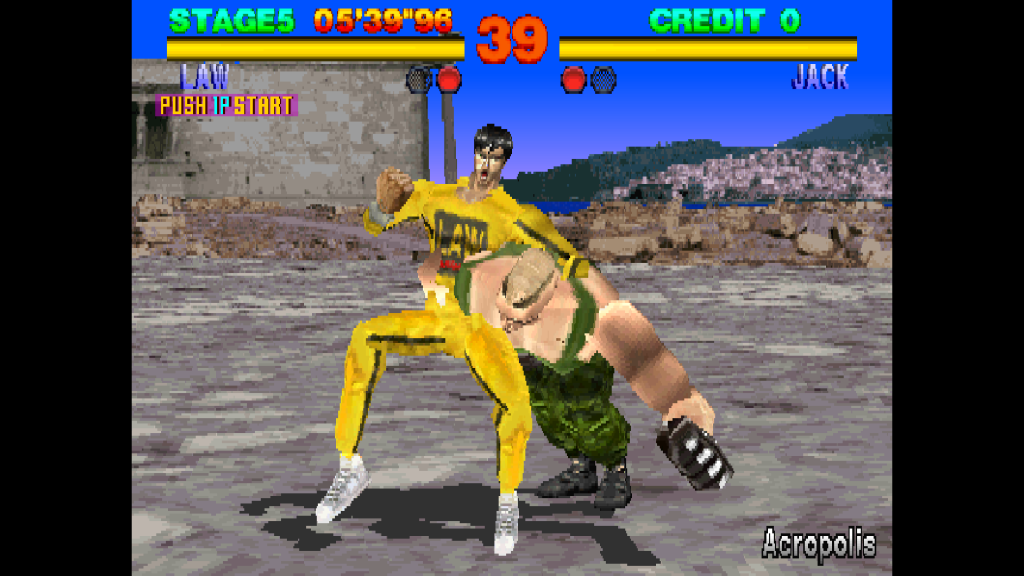
The cast of characters might be slim, but it’s easy to find a favourite, and there’s respectable variety between them – from Law’s frantic kicks to JACK’s lumbering blows. Attacks feel impactful, and battles can be tense. Like Street Fighter II before it, most rounds are over in around 15 seconds – a blistering succession of punching and kicking combos, rushing attacks, crunchy throws, and special moves that, more or less, follow the laws of physics. Rising attacks give you the chance to turn a fight around, making attacks on floored foes a risk worth weighing carefully. Coming back from the brink of defeat is always a possibility if you’re skilled. Adding to the degree of unpredictability, the AI is peculiarly fond of taking a pasting during the first round, only to retaliate with a ‘perfect’ during the second round – leaving the final round as a vital decider. Once you start achieving several ‘perfects’ in a row, you know you’re on course for full character mastery – and great satisfaction can be had from that.
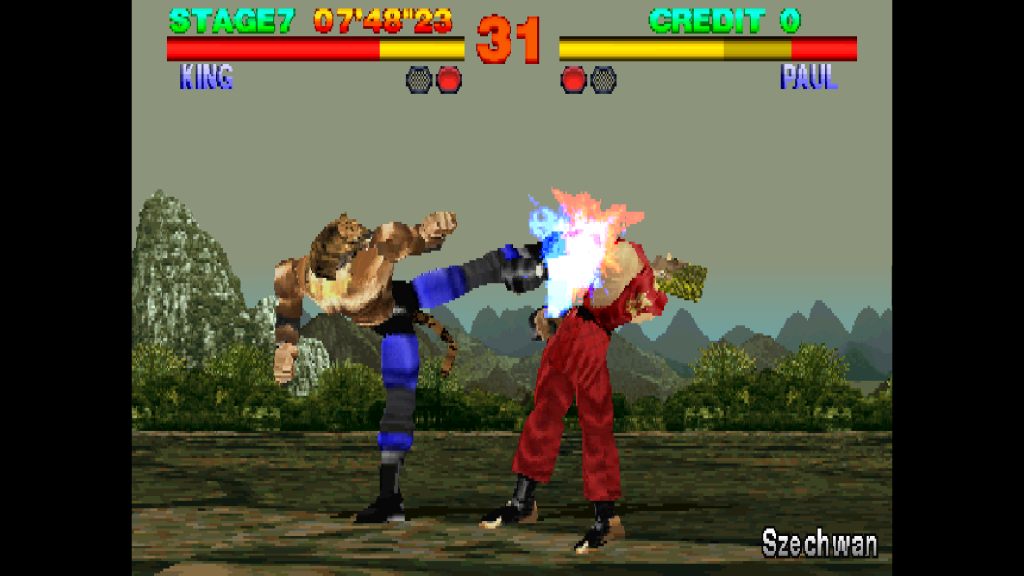
Arcade mode lasts 10–15 minutes, pitting you against every character, one additional secret clone character – which became unlockable in the PS1 conversion, greatly expanding the roster – and then the final battle against Heihachi, who was clearly designed to snaffle a couple of extra credits from players. There’s a very brief CGI intro – which owners of the PS1’s famous Demo One will recognise – while the ending screen shows a compilation of your finishing blows; a nice enough touch. A practice mode is available that shows damage ratios, and Hamster has been kind enough to provide move lists for all eight characters, along with bios. There is a choice of difficulties, and the time limit can be adjusted. It’s possible to save anywhere too, while other options include wallpapers, screen filters, and button mapping.
Helping to expand things further are the typical extra modes found within the Arcade Archives line, each with online rankings. Hi Score Mode involves beating as many enemies in a row as possible on a single credit. If you manage to reach the end – with some skilled players posting times in the 3-minute vicinity – then your time is posted too. Caravan Mode lasts for five minutes and entails beating as many enemies as possible on a single credit, with the number of rounds set to five. A remarkable 30 is the current score to beat. Time Attack, meanwhile, simply involves beating the arcade mode as quickly as possible. Under five minutes will get you into the top ten currently.
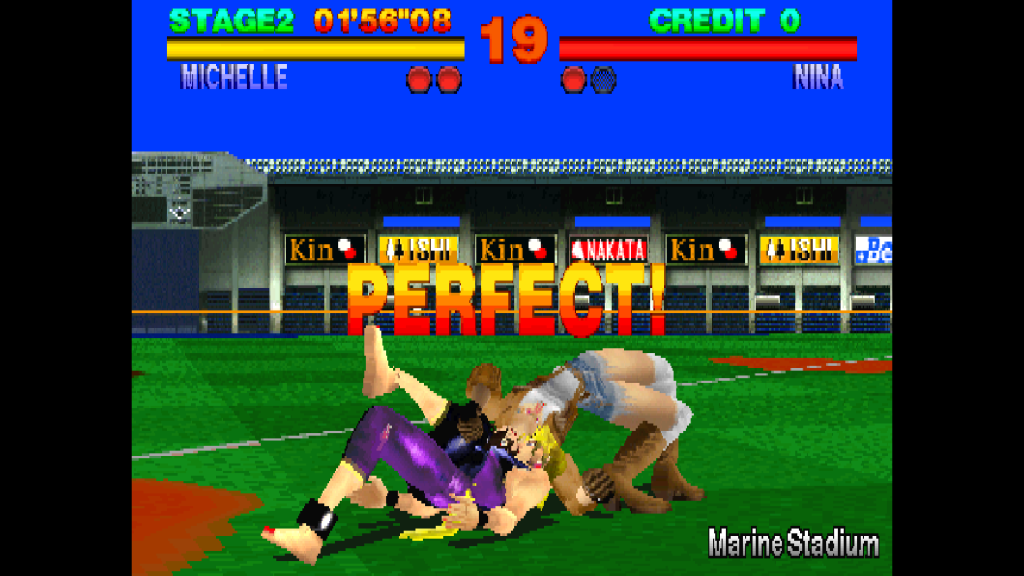
Tekken is unquestionably a product of its era and has aged when it comes to presentation, with textures far scruffier than we remember and the occasional ill-fitting colour scheme for some alternative outfits. Character models are quite chiselled and angular, and texture warping is common. Animation fares much better, making for something that still feels fluid and fast-paced. The effects that accompany each blow are curiously appealing too. The music, meanwhile, has a CD-quality to it – complete with generic ’90s dance undertones. The use of pixel art within the in-game score tables and backdrops serves as a reminder that this was a product created during the 16-bit to 32-bit transition, which is mildly interesting to see.
The Tekken franchise knew no bounds, with each sequel expanding on the last. It was this original that implemented the sturdy foundations to build upon, while introducing a cast of characters that many a fighting fan quickly grew to cherish. It’s definitely showing its age visually, but it is still capable of hosting astonishingly close battles between friends in two-player, where you’ll need wits as well as a fully memorised move list to come out on top. Indeed, it holds up surprisingly well mechanically. In all, going back to Tekken today reveals a scrappy brawler that’s predictably lean but still able to deliver a few energetic rounds of fisticuffs.
Hamster’s Arcade Archives 2 Tekken is out now on PS5, Xbox Series and Switch 2. Original game by Namco.