
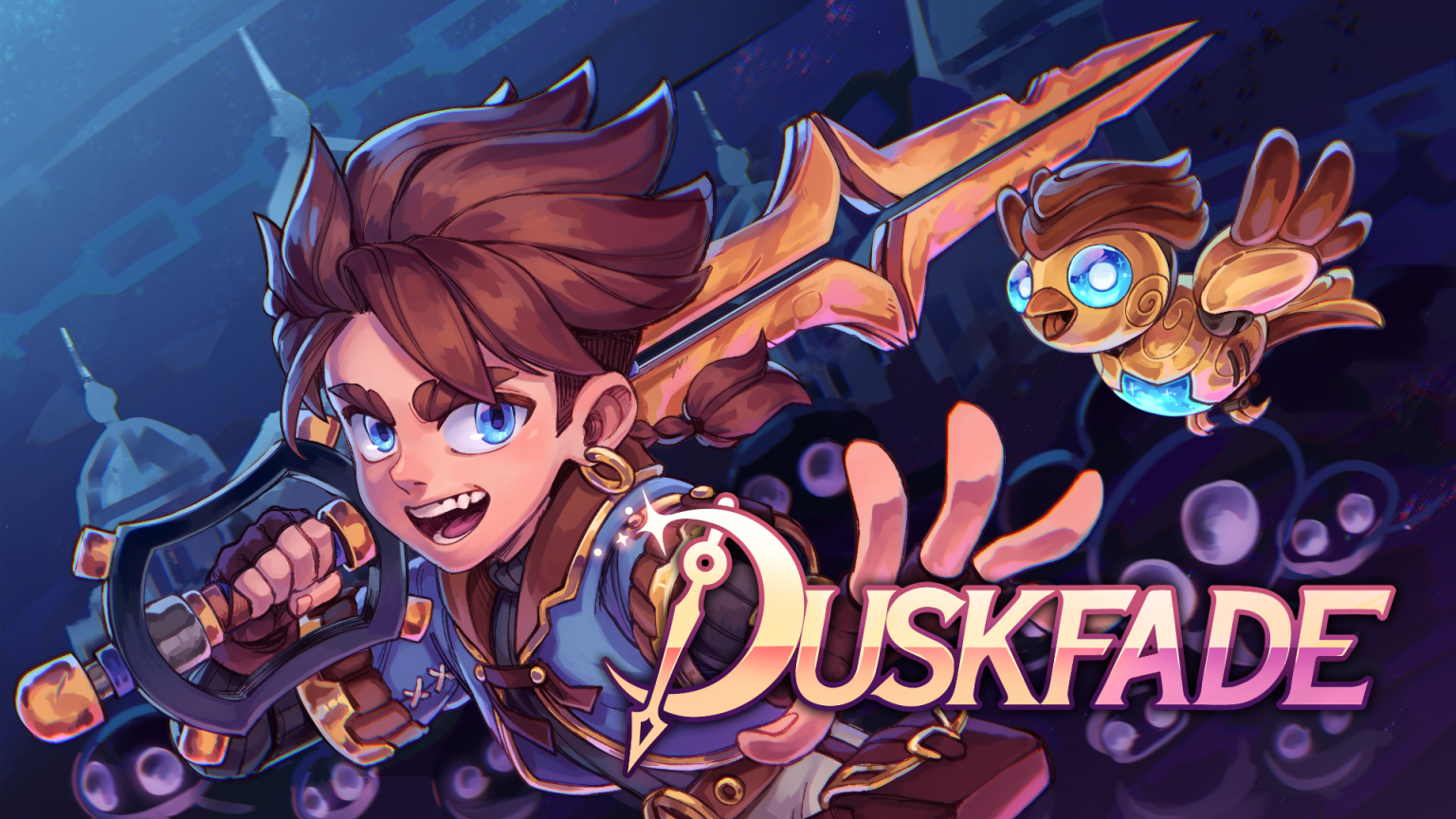
It says something when you find yourself bringing a game’s protagonist to a standstill just to pan the camera around and gawp at the visuals. Open platformer Duskfade is a fine example of this, with many of its fantasy locations leaving an impression. Spanish developer Weird Beluga has managed to employ every Unreal Engine 5-powered visual trick in the book, from beautifully lit and richly detailed indoor environs to sun-drenched outdoor locales with billowing grass. Also remember to look up, as Duskfade is blessed with one of the most intricately detailed skyboxes of recent times. You’ll definitely need to stop for a few seconds and take it all in.
A ‘destroyed beauty’ ethos is present throughout, tying into the storyline. Duskfade takes place in an ornate clockwork world populated by grand structures, quaint villages, stained-glass halls, and magical floating cloud kingdoms – all of which have been torn apart and perforated by translucent crystal shards. This wasn’t the work of a villain – although one, known as Despair, fulfils that role – but rather our floppy-haired hero’s sister. She foolishly meddled with magical powers beyond her control, leaving this fragile world on the brink of collapse. Only Zirian, an apprentice clockmaster, can restore the fabric of time and put things straight.

Duskfade is inspired by such PS2 greats as Jak & Daxter, Ratchet & Clank, and Kingdom Hearts – with Zirian carrying a clock hand that acts as an impromptu sword, and joined by a robotic cuckoo who can decipher memories of the past. While you will see elements of PS2-era platformers present, it remains quite contemporary, largely thanks to its sizeable levels. Its four worlds each take around two hours to traverse, and while they are themed (desert, lava, ice, sea, etc.) they involve long treks across their outskirts before arriving at key locations, be they high in the air or submerged underground, taking you through villages, forests, catacombs, and shredded otherworldly realms beforehand. Defeating a boss doesn’t necessarily see a stage come to an end either, often with a few more areas to explore before concluding.
Levels are peppered with portals that not only act as checkpoints but also a means to return later in search of secrets, helping the world to feel connected. It’s also possible to return to the cloud-critter populated hub (Tick Town) mid-level to add new moves to your repertoire. Within the town you’ll also find a scallywag to play hide and seek with, a tailor able to knock up new threads in exchange for rare coins, a blacksmith who can change weapon colours, and a musician seeking scattered music boxes – which commence a memory-based mini-game when found, unlocking new jukebox tracks if successful.

Tick Town’s branching paths lead to new stages, most of which are accessible only after obtaining new skills. These are drip-fed at a rate of one every hour or so, assisting with diversifying and expanding traversal, with the first extra being a grappling hook. Controls feel intuitive and responsive, with the only downer being that grappling spots only activate when you’re mere yards away. They’re always visible; they just require proximity to activate. Most traversal sequences call for careful timing, performing several manoeuvres in succession.
Later, rail grinding comes into play, seeing Zirian cross great distances swiftly. This mechanic is deeper than expected, even involving hitting switches before performing a 180-degree spin to backtrack and access a freshly opened route. One stage has so many sprawling rails to grind that it recalled the recent Denshattack – from the same publisher, funnily enough.

There’s the combat to take into account too, which has its own upgrades. Four cooldown-governed special attacks feature in total, with the first being a short-range projectile blast. Combat itself is of the hack ’n’ slash variety, livened up by the need to dash and dodge often, as a surprising number of enemies explode upon defeat. Despite being noticeably fluid, combat is still a little one-note to begin with, relying on a simple three-button combo to dispel a range of blob-like creatures. It becomes more in-depth around two hours in when a heavy-hitting pendulum blow is added, intended to defeat shielded foes. Your cuckoo pal plays a part in combat too, able to mop up stragglers – and can later gain a three-way shot.
Acting as a reprieve from the combat and traversal sequences are the mid-stage boss fights. A handful are just as challenging as the end-of-level battles, and most battles require a few attempts. Duskfade is, however, guilty of following a pattern; almost every boss fight takes place in a circular arena, and after whittling down a boss’s health, you’ll at some point need to traverse around said arena to destroy something, such as a power source. Every fight has different mechanics; they simply follow the same formula. Once a boss is weakened or stunned, only around a minute is given to leap and grapple around the outskirts to complete your objective. Take too long, and Zirian’s health will begin to drain – which not only triggers an annoying “Ugh!” sound but also makes the controller vibrate. Having to contend with this while performing carefully timed jumps can be frustrating, to the point where during one fight I ended up turning vibration off. Still, the draining-health aspect does make boss fights feel rather tense, and they put more than just your combat skills to the test.

Another minor issue is that most upgrades require cogs, which are seldom discovered unless you scout high and low. By the game’s end, I had 9,999 crystal shards to spend but couldn’t buy anything due to a lack of cogs. Presumably, this was to encourage searching for secret areas. It tracks your progress well, with each portal showing collectables not yet found and highlighting areas explored fully. My playtime stood at just under nine hours, flicking between the two easier settings. Story mode is, unsurprisingly, exactly that. To see and find everything, you can probably add another three to four hours to that total. I think most players will want to spend additional time in Duskfade’s dreamlike world, and may even find themselves returning to it the moment the ending screen fades to black. The main characters and supporting cast of curious clouds are instantly likable, while the diversity of the stages – none of which have a single theme, but rather deftly incorporate multiple – makes them a joy to explore fully.
Duskfade is one of those rare examples of something so polished and confidently delivered, knowing exactly what it wants to be and the kind of experience it can provide to players new and old alike, that most publishers would be proud to have it in their portfolio. While it may retread some old ground – it’s born out of a passion for genre greats, after all – it successfully manages to shatter expectations too. Following on from last month’s Denshattack, it’s another feather in the cap of publisher Fireshine.
Weird Beluga’s Duskfade is out 13th Aug on PS5, Xbox Series, Switch 2 and PC. Published by Fireshine Games.